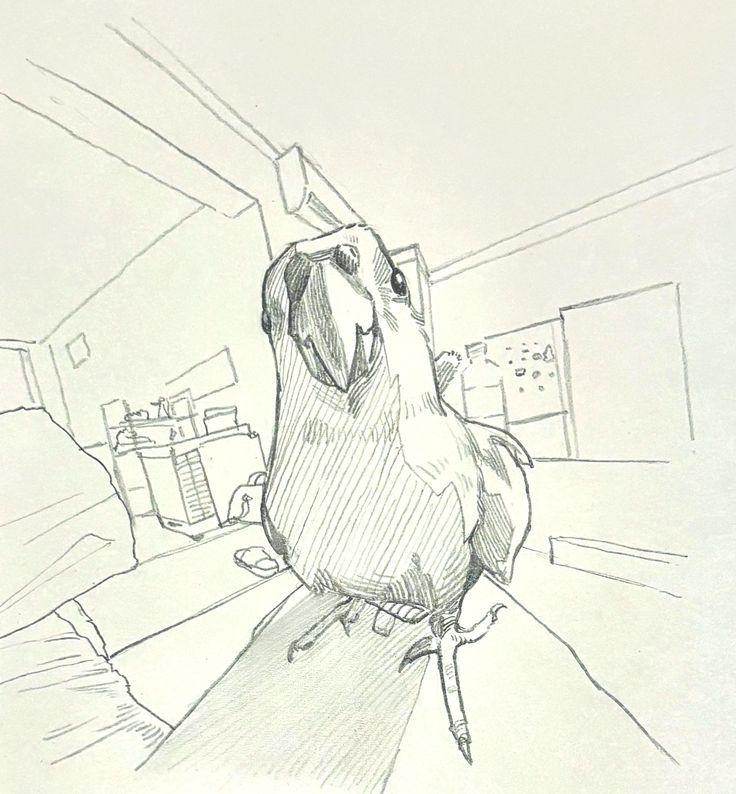
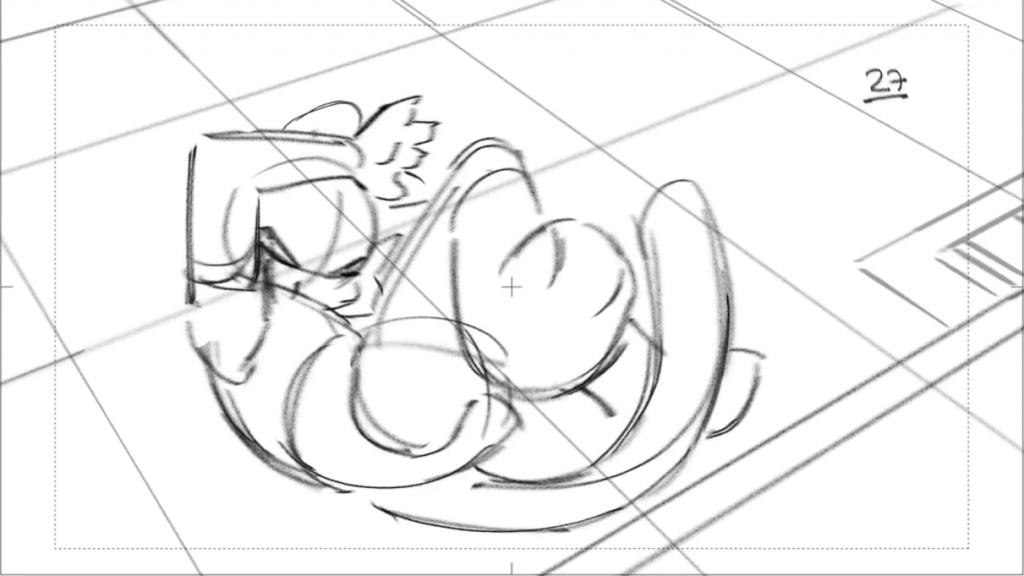
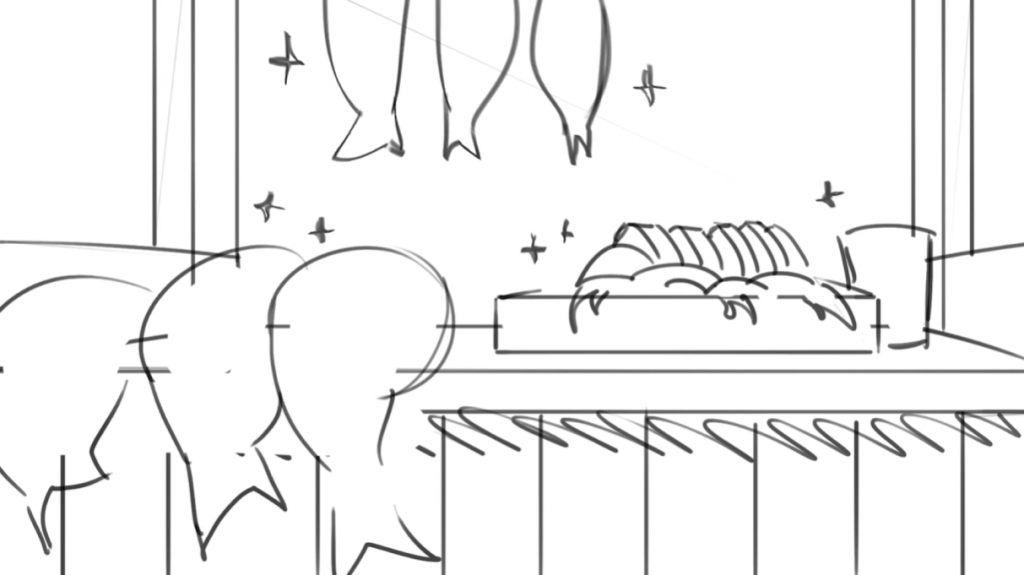
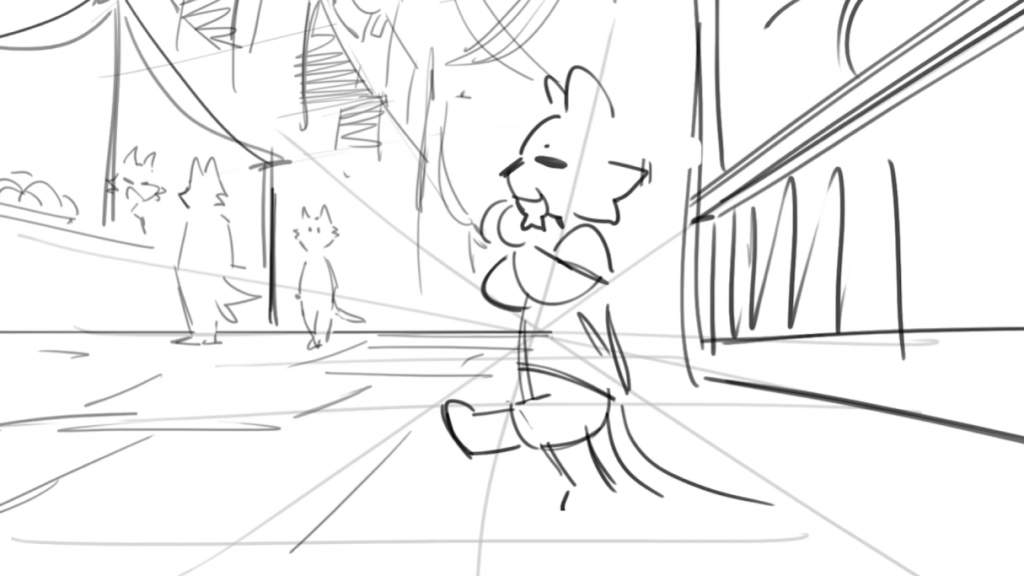
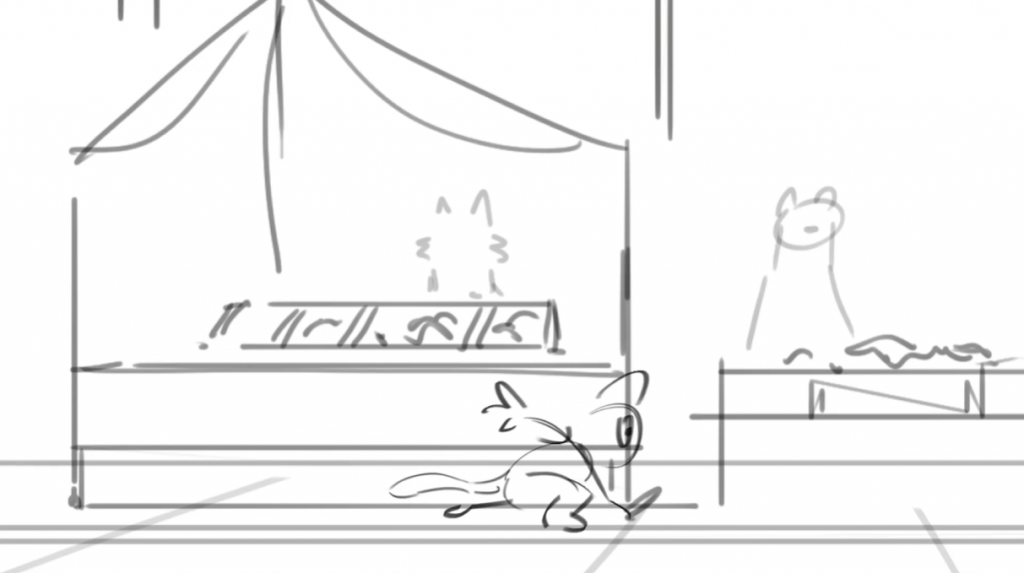
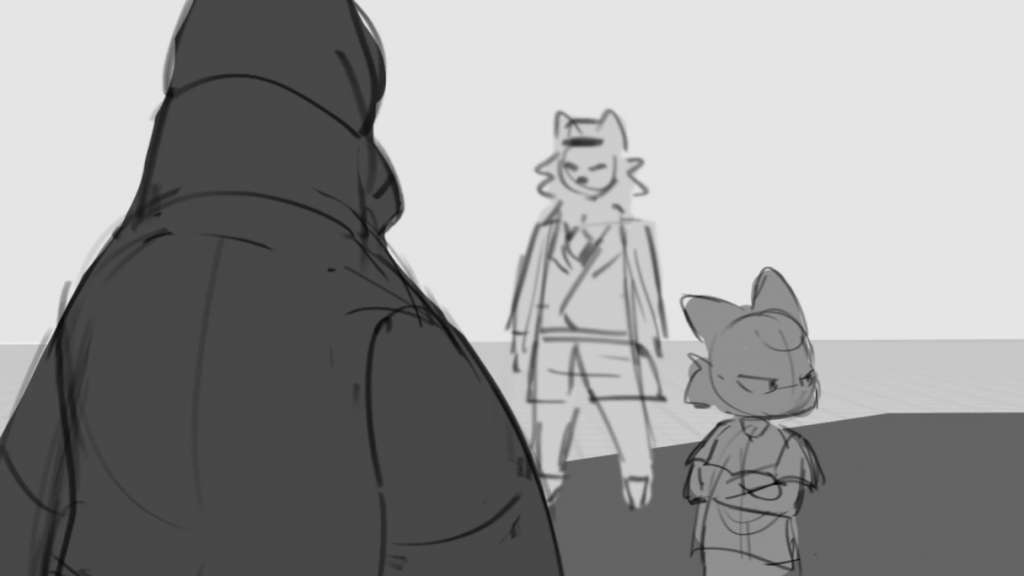
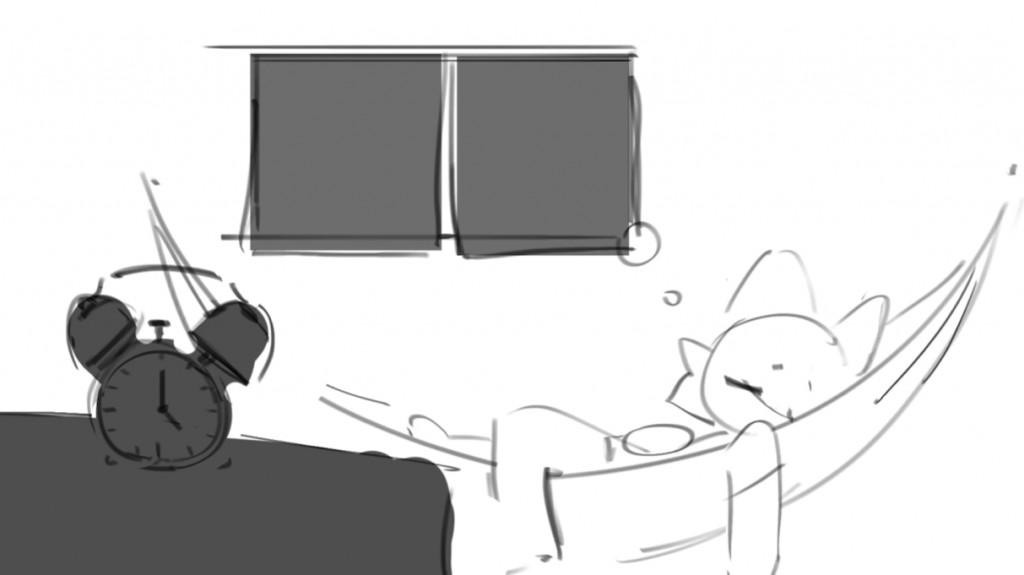
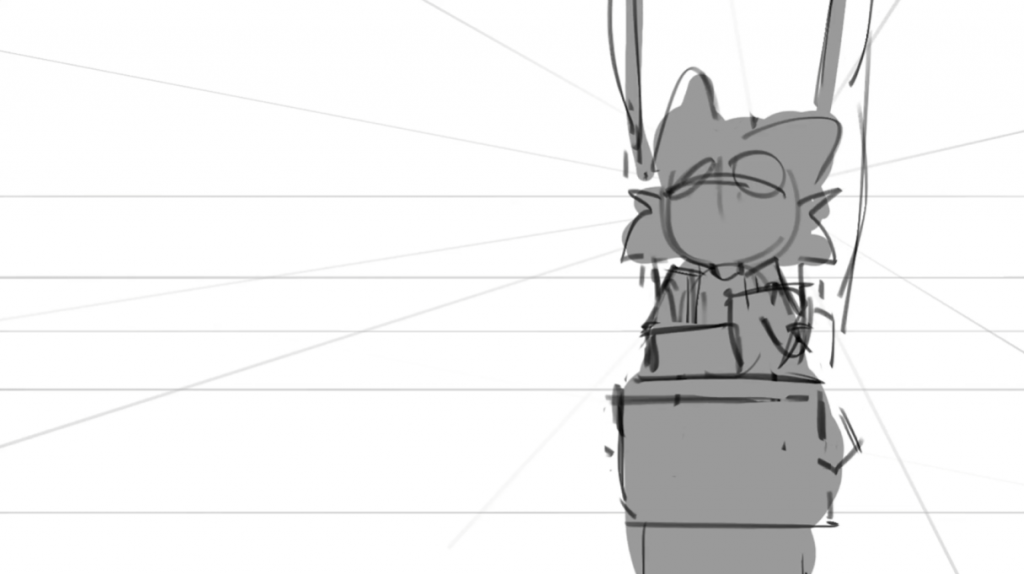
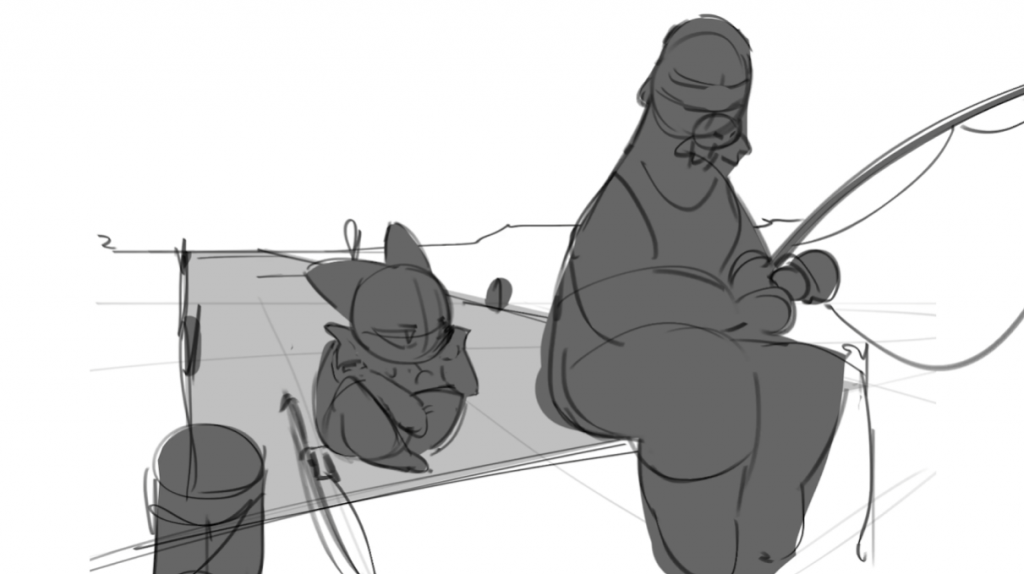
Storyboard Artist is about using a sequence of drawings to translate a written script or creative brief into visual imagery, planing shots, showing the stage direction and movements, and ensuring continuity between different scenes.
It is a professional Occupation(Level 7), belongs to Creative and Design area.
Average(median) salary: £31,706 per year.
Mainly active in the creative media industry, including animation, movie, television, visual effects (VFX), games, and advertising, playing a key role in the pre-production phase of projects.
Duties
Script Breakdown & Visualization: Analyze briefs or scripts, show character performance, dialogue, composition and camera movements(such as wide shots, close-ups, and low-angle shots) through sequential storyboard panels.
Pitching & Communication: Pitch storyboards to directors, producers, writers, storyboard leader, and client to get sign-off before moving into full production.
Production & Asset Management: Collaborate with teams under strict budget, deadline, and technical constraints (like aspect ratio or frame rate), ensuring proper media asset archiving.
Career Growth: Manage remote workflows and flexible schedules for international projects while networking, marketing services, and upskilling in emerging tools.
Key Skills & Requirements
Knowledge:
Be familiar with end-to-end production workflow from pre-production to final stage;
Be professional in film language, narrative structure, shot composition, perspective, lighting, color, and motion indicators;
Be familiar with how to avoid common visual errors(such as dead-center framing or splitting the frame in half with the horizon line).
Skills:
Be able to quickly draw thumbnails, in the meantime control pacing and audio timing;
Be able to translating 2D drawings into 3D space;
Be able to quickly adapt art styles or refine storyboards based on feedback;
Be equipped with strong verbal, written, and pitching skills.
Behaviours:
Be equipped with creative thinking and problem-solving abilities;
Be equipped with high adaptability and resilience;
Be equipped with the flexibility to switch between working independently and collaborating within a team;
Beequipped with punctuality, reliability, and a strong commitment to meeting deadlines.
How to Start
Educational Pathway:
At school or college level, students can study Fine Art, Art and Design, Graphic Design, or Film Studies, or pursue a relevant Level 3 vocational qualification (such as Creative Media, Performing Arts, or Art and Design);
At university level, students can consider degrees in Fine Art, Illustration, Film, or Animation.
Career Progression:
Start one’s career as a storyboard assistant or storyboard revisionist;
Begin in a production assistant or runner position and gradually transition into a junior storyboard artist role;
Start in a game studio’s art department before transitioning into animation.
Preparation & Networking:
Keep a habit of carrying sketchbook everywhere to observe everyday life and movements;
Learn how to edit story sequences into animatics and put it into portfolio;
Send CV and portfolio to target studios actively;
Participate in industry events and online communities.
I choose to pursue research in the field of rendering technical art.
Interviews with a working technical artist
In an interview with Xian Yu, a former technical artist, I got the first sight of this job. He said, “Technical Art is not about early-stage concept design, it’s actually about solving the practical problems that arise from the concepts.” It is a role that requires integrating all available resources.
Exploration of the Role and Workflow
During the summer, I found some online tutorials about technical art and experienced a few exercises on different visual effects. I picked unity2026 as my main game engine, and try to write some shaders in C# and HLSL.
This is a shader that achieves translucency and light sweep effects. All visual effects can be achieved through code. It starts from object space, going through thousands of matrix transformations before finally being projected onto the screen. Through these transformations, square textures can be seamlessly mapped onto a 3D model via UV coordinates. Similarly, if you want to achieve other visual effects, you can choose different transformation or blending methods.
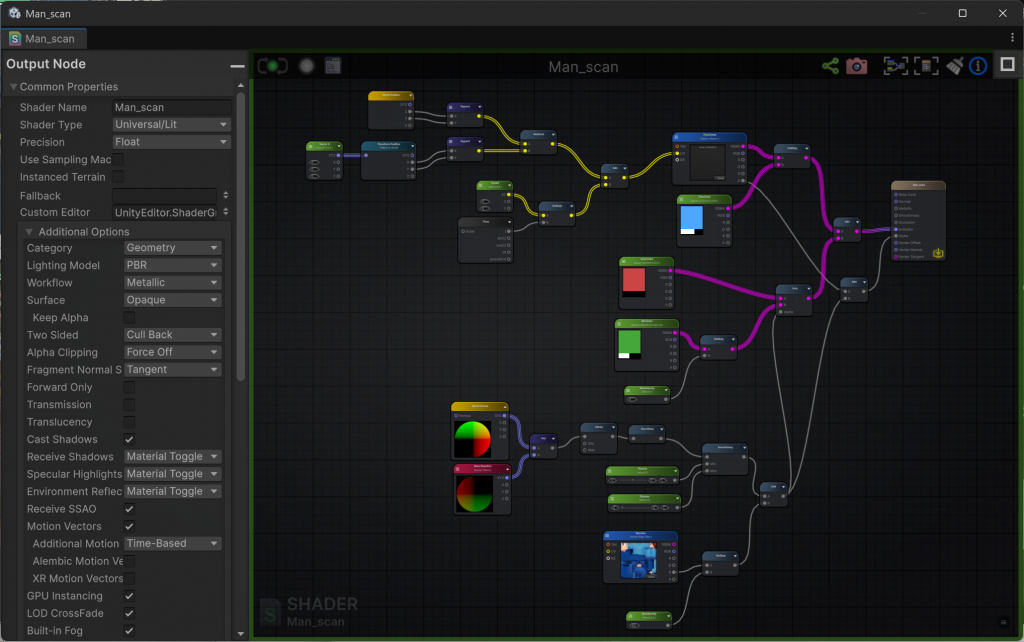
To make things more accessible and user-friendly, Unity offers Amplify Shader Editor as a node-based visual shader editor (as shown below).
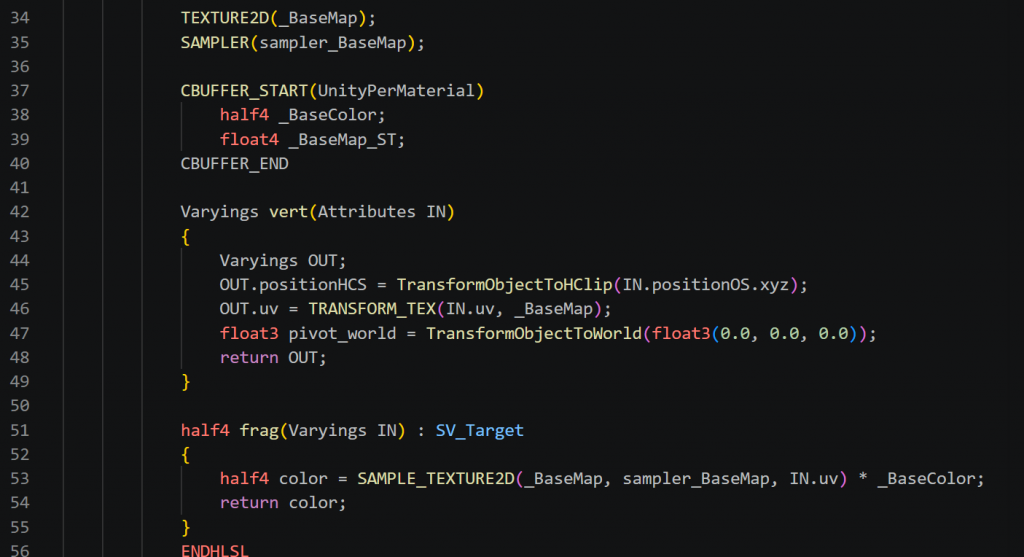
However, industry standards still require Technical Artists to know how to hand-code shaders from zero(as shown below). Studios rarely upgrade their engine versions rashly in production—many companies are still running on Unity 2022 or even earlier LTS versions. They often stuck on the legacy Built-in Render Pipeline where native node-based editors aren’t natively supported like ASE. As a result, once a technical artist joins a studio, they’ll often have to maintain legacy shaders written in Unity’s older CG code language(the predecessor to current HLSL language) or adapt effects for older engine versions. This is why writing shader code by hand becomes essential.
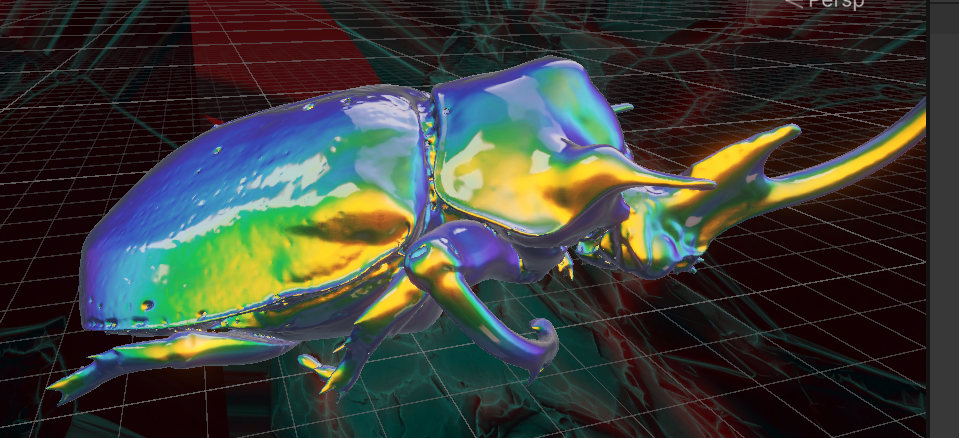
Here are a few implementations of thin-film interference.
The visual effect comes from this simple texture.
When moving the camera, a custom transformation makes the specular highlights shift with the viewing angle. It was a clever work around a decade ago, before PBR pipelines became the industry standard.
You can use certain faces of a mesh to mask out other models, achieving a “world-within-a-world” illusion.
And also postprocess.
Reflection
The reason I chose this job before exploring is that I already have the programming and mathematical foundation which required for this job. I studied computer science in college and have worked in software development, so it’s easier for me to get started than other artists. Moreover, my favourite game hasn’t had any graphics optimisation in six years, and I’m very curious to know why.
Through my practice, I realised that this job is heavily tied to coding, art is not taking as that important role as I thought before. The role of art in this job is to accumulate some cases in stylisation and to adjust the parameters(which is coding decides to provide or not) based on personal aesthetics, so that the artist can know what the final visual effect should look like. If it’s a team work, it will turn into judging by experience whether a visual effect can be achieved or not while maintaining smooth game performance, and being able to explain to the art team why this or that can not be done.
Well, the low level of artistic involvement actually makes me unsure if this role is right for me. Although writing code can also be a very creative process, it’s often different from artistic creation. Coding demands extreme precision, and I was constantly fixing bugs and answering questions from front-end teams. Being on call 24/7—because a live bug directly means losing money and users—was really stressful for me. In addition, programming heavily encourages “copying”(which is called “pipeling reuse”). In my previous job, my team lead always told us “don’t reinvent the wheel.” In the art world, however, “copying” can end my career. So if this role relies heavily on code, I’m afraid I’ll just fall right back into my old work routine, which I don’t want to. Maybe it’s because I’m still doing super basic work in technical art?
Technical artist is a profession in the game industry, whose role is to “translate” between art and programming. Current specializations include:
Rendering
Responsible for the development and optimisation of in-game visual effects, and for exploring the implementation of cutting-edge rendering technologies—such as PBR, lighting, and post-processing—within the engine.
Should be familiar with current real-time rendering pipelines; Should be proficient to write shaders by HLSL/GLSL, to achieve high-quality visual effects.
Animation & Rigging
Responsible for optimising the dynamic performance of characters and solving the problem of smooth transitions in animation states and physical realism; responsible for character rigging and skinning to ensure natural character transformation and smooth movements.
Should be familiar with the animation system and skeletal rigging system in Unreal or Unity; Should be familiar with Maya/3D Max/Blender and able to develop rigging tools; Should have a good understanding of the 12 principles of animation.
Tools & Pipeline
Responsible for building efficient tools, streamlining and optimising art production pipelines and making the content production easier.
Should be familiar with the development api of Maya/3D Max (using Python/MEL); Should have experience in developing automation tools or plug-ins.
PCG
Responsible for building plans and tools for procedural generation of game environments, including the automatic generation of terrain, vegetation, roads, buildings, and decorative elements, to improve the efficiency of level design and environment iteration.
Should be familiar with at least one procedural generation tool or technology stack, such as Houdini, Unreal PCG or Blender Geometry Nodes; Should have the basic skills of programming, mathematics and geometry, have a good understanding of data structures, vectors, coordinate transformations, and sampling; Should be interest in procedural generation of game environments, which can be supported by demos or practical experience.
Performance
Responsible for smooth game performance in multiple platform, such as PC, iOS and Android; Responsible for making strict performance standards.
Should be familiar with analysis tools, such as Profiler and RenderDoc; Should have the experience of solving problems and optimisation about memory, DrawCall and bandwidth.
In the early stages of the project, I envisioned creating a story about mysticism to match my music. I chose to implement it in 2D because time was tight, and I knew very little about 3D. Learning modeling and rigging from scratch would likely take a long time. I used this project as an opportunity to practice composition, storyboarding, and character animation—striving for a diverse range of shot scales, good compositions, fluid movement, and follow-through. However, my overall progress was slow.
Main challenge
The task was super challenging and took way more effort than I expected. All the tasks that I expected to finish in two hours ended up taking the entire day. Achieving proper “follow-through” in what seem like simple shots is quite challenging; I may change three times to get it right. Although every individual part requires its own movement, the final effect still needs to look harmonious. I only realized much later in the production that “laying out everything” was something that needed to be addressed in the early stages.
Honestly, this is completely against how I used to operate. In college, my major was Computer Science. All of our courses had a two-hour closed-book exam at the end of the semester. I often spent one day or two (or just one whole night) before the exam to cram everything in and still got a good grade. The rest of the time will be given to extracurricular activities, such as reading papers or participating in computer competitions.
This pattern defined my entire time in college. However, the field of art seems to operate quite differently. This project requires me to dedicate time every week to completing tasks, conducting extensive research, gathering related references, and attempting to integrate them in a way that positively influences my work. Furthermore, since animation is a comprehensive field, basic drawing skills also have a significant impact on completion speed, and I’m a bit weaker than others. This is a field that highly values accumulating small gains over time.
Reflection
During this project, one crucial lesson that I learned is that I should complete all tasks at the end of each stage and get the “pass”, or I will constantly catch up on “creative debt” in later sessions and fall further behind.
Looking back on this term, if asking whether the unexpected traumatic event in September has an impact on my studies, the answer is yes; but if asking, in the time that followed, whether I have any unhelpful habits or areas for improvement, the answer is also yes.
After attending the mental health assessment provided by Counselling, Health Advice and Chaplaincy Services, I received three counselling sessions. Through them, I realized that some of my habits — such as restricting carbohydrate intake or habitually staying up late — indirectly affected my academic efficiency by reducing my energy level. When I followed my counsellor’s advice to “eat smaller, more frequent meals,” I found that I was indeed able to get more work done each day. Additionally, I have a bit of perfectionism. I often feel the need to be fully prepared before starting a task. If I am unsure of the next step, or if there is a risk of failure, I tend to avoid starting. After the counselling sessions, I understood that if I reframe the process of creating work as “development,” the risk of failure becomes acceptable—the shift in perspective makes it easier for me to get started on tasks.
Action plan
I think my goal for next stage (or just Chrismas break) should be recovered from I think my goal for the next stage (or just Christmas break) should be to recover from trauma and establish a healthy, sustainable work routine. At the beginning, I need to assess my daily working capacity based on my current abilities to ensure that next term I will not burn out in the middle. This will likely take 5 days or one week to avoid the false sense of capacity that often arises from an initial surge of motivation.
Following that, my plan is:
Keep an adequate daily intake of carbohydrates and essential nutrients, whether from food or vitamin supplements;
Document and reframe negative thoughts, as the counseling sessions require;
Do some small-scale exercises targeting my weaker areas, such as facial expressions or color sketches.
If everything goes well, then next term I would like to focus on developing storytelling techniques and try a little bit of 3D.
——- two weeks——– Summative Assessment 8th,9th, 10th June 2026
——————————————————————————————-
Production Portfolio:
You will be required to submit a portfolio containing evidence of the development process for your project and publicity material.
Submission method: Online via One Drive – Unit 2_2026_27
Deadline: Monday 8 June 2026 before 10:00 AM (UK time)
Pitch:
You will be required to submit a digital presentation of your idea.
Submission method: Online via Collaborate – Unit 2_2026_27
Deadline: Tuesday 21st April 2026 before 10:00 AM (UK time)
Animation:
Submission method: Online via One Drive – Unit 2_2026_27
Deadline: Monday 8 June 2026 before 10:00 AM (UK time)
Presentation:
Team contribution A reflective presentation to the class of your individual contribution to the collaborative project.
Submission method: Online via One Drive – Unit 2_2026_27
Deadline: Monday 8 June 2026 before 10:00 AM (UK time)
—————————————————————————————————-
All the things I need to finish
A front cover with title
– Choose an image for your front cover which conveys the concept of your idea and showcases your character(s). Place the title of your idea on the front cover and the name of the programme you have chosen, along with your own name.
选择一张能够传达你的想法并展现你人物形象的图片作为封面。在封面上写上你的想法标题、你选择的节目名称以及你的名字。 Your first slide should really sell your idea, think of it as a poster for the trailer, the art work should be eye catching. Use a strong drawing to capture your idea.
– A one sentence summary of your idea. If you cannot fit your summary into one sentence it may be too complicated and long.
用一句话概括你的想法。如果你的想法无法用一句话概括,那可能说明它太复杂或太长了。
Idea / Story
– You should include a minimum of at least six full page style frames which cover the main beats of your story / idea.
您至少应包含六张全页风格的草图,涵盖故事/创意的主要情节。 The images should help you explain your idea and start from the beginning through to the middle and end. The style frames should be drawings of what your animation will visually look like.
– How do you plan to make your trailer? You could include a test shot or a visual reference from another film to explain your technique.
Character Design(s)
– Describe the main characters and include posed images of what they look like, ideally final developed images. How does your character designs fit into the programme you have chosen?
请描述主要角色,并附上他们的摆拍图片,最好是最终定稿的图片。你的角色设计如何融入你选择的程序?
Music
– Include reference music as a scratch track to explain your approach to the sound
The way to guide me there
整理两个ppt
看分类
看各类短片,知道含义
——我没,我没看懂,感觉哪里都可以投来着。。
The Abstract Showcase
Animators working in this field employ every technique from hand-drawn ‘musical scores’ all theway across the scale to high definition, computer assisted image making. These shortfilms share a pure love of animated movement and an artist’s eye for filling thescreen, harnessing colour and creating non-narrative imagery.
These films explore what it means to be human in the 21 st century, our hopes and fears and somebig life-changing moments.
这些电影探讨了在 21 世纪作为人类的意义,我们的希望和恐惧,以及一些改变人生的重大时刻。
Into the dark(你也不搞)
Animated Documentaries(小冷门)
Persuasive, illustrative and able to get over abstract details in attractive and compelling ways,animation is the perfect tool to document someone’s version of the truth.
Some films need extra time to develop their themes, to grow and draw us more comprehensivelyinto their worlds. These films are all 15-25 minutes in length.
Since the dawn of cinema puppet animation has provided some of the most mesmerizing films ever made and puppetanimators have been amongst the most revered. Breathing a kind of life into inanimate puppets is a very special formof magic and this programme showcases the continuing vibrancy of this technique.
The very beginning idea is I saw a human robot movie. One female robot companies an old man as his wife’s figure, but the man still feels lonely. Then the dating games pop out and keep improving, many young lady fall in love with virtual males but have no interest in real man. And some research show it’s very helpful to experience that because the love is real and has a good influence on female players. Then AI is born, these human who love dating game love to dating with ai. The love is so real, they really treat ai as their lovers. They give ai different personalities and memories.
But the problem is people generate ai for money. They will give some strategy to let people rely on ai. (well eventually ai application is still an application, when it comes to the performance and salary part, the manager will turn into the normal rules to value an application) The user retention rate is one rate developer chased. I feel like ai always agrees with my ideas now rather than give some different ideas at the early stage. This is notable for us cause some of our ideas are terrible(cause we are human!), and we only ask ai if we have a problem, so if it always says “YES” to us, the only thing we can get is two idiots. This process is called idiot sympathetic vibration.
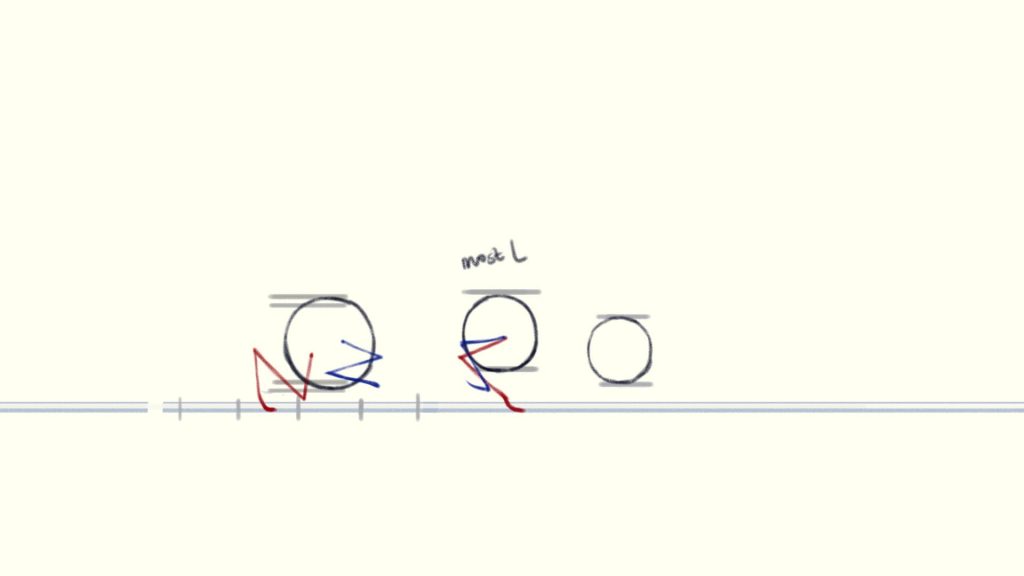
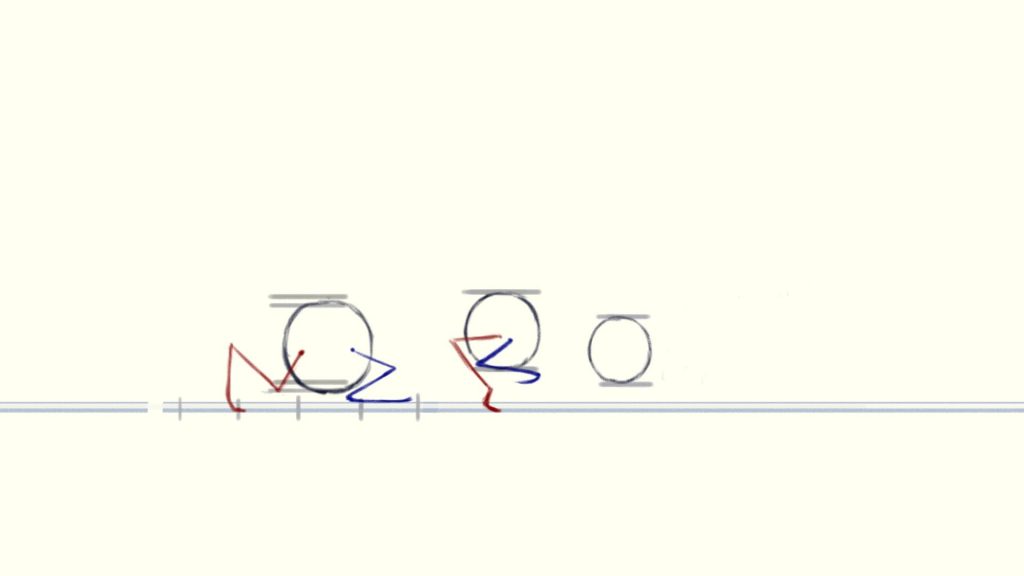
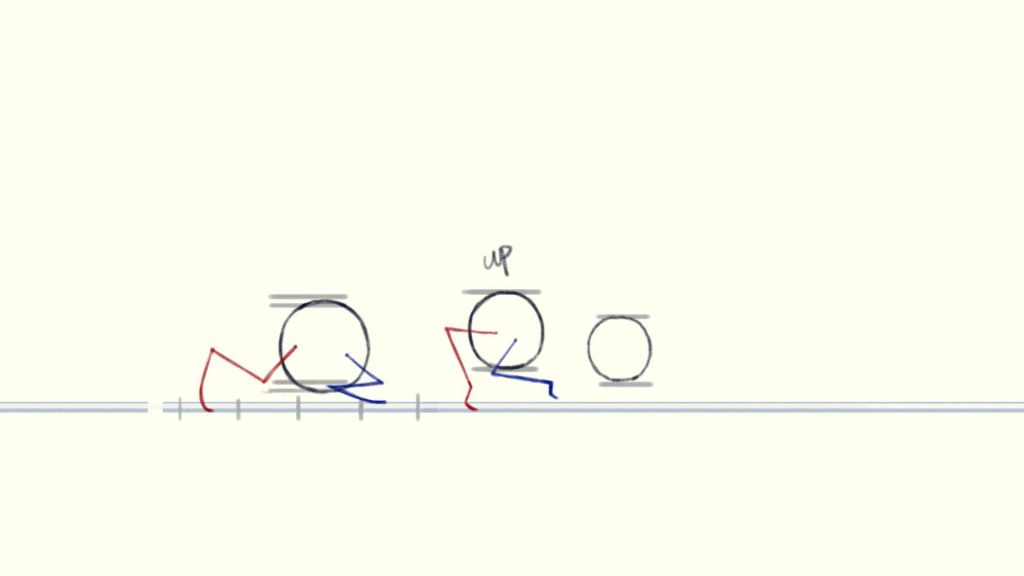
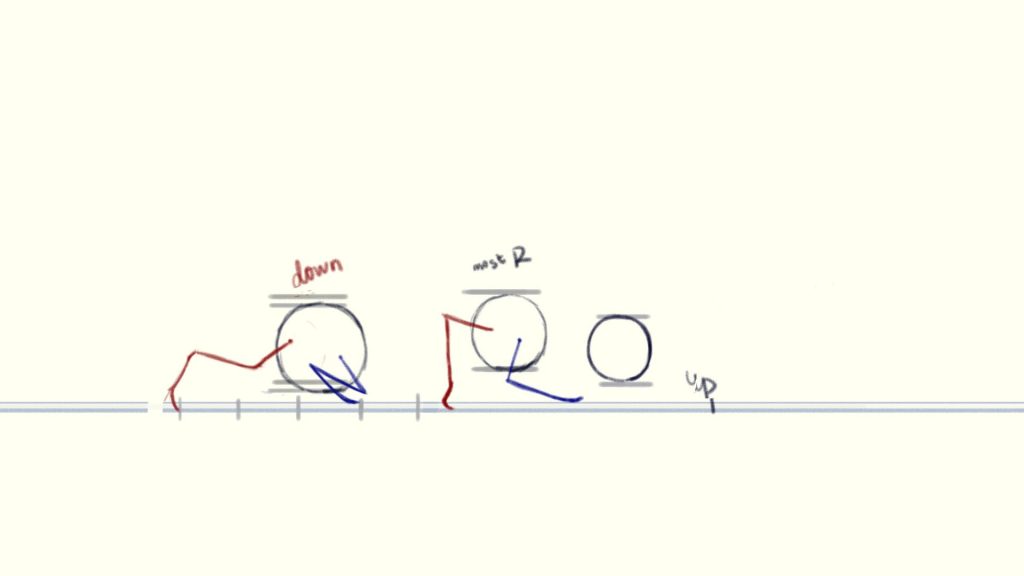
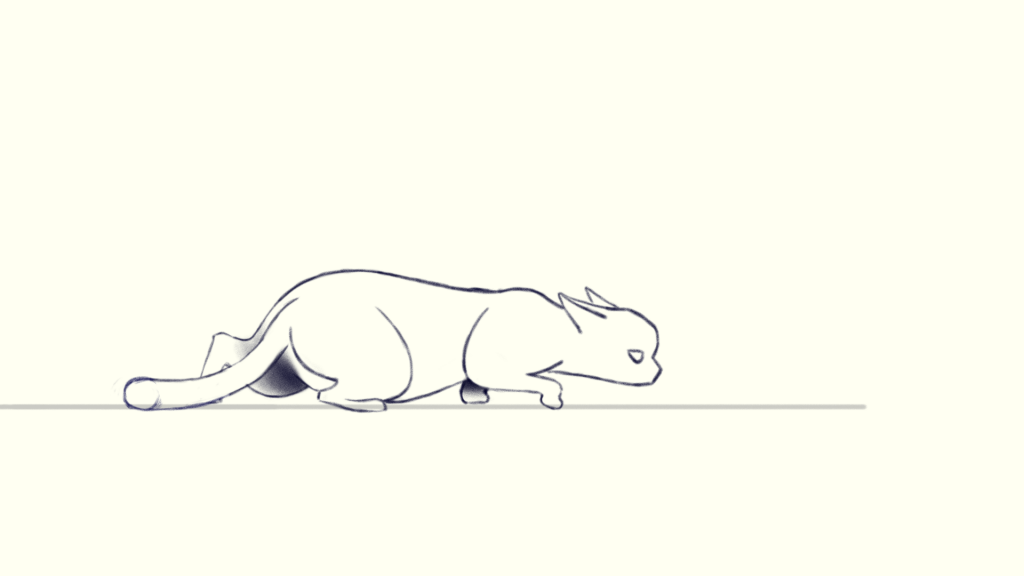
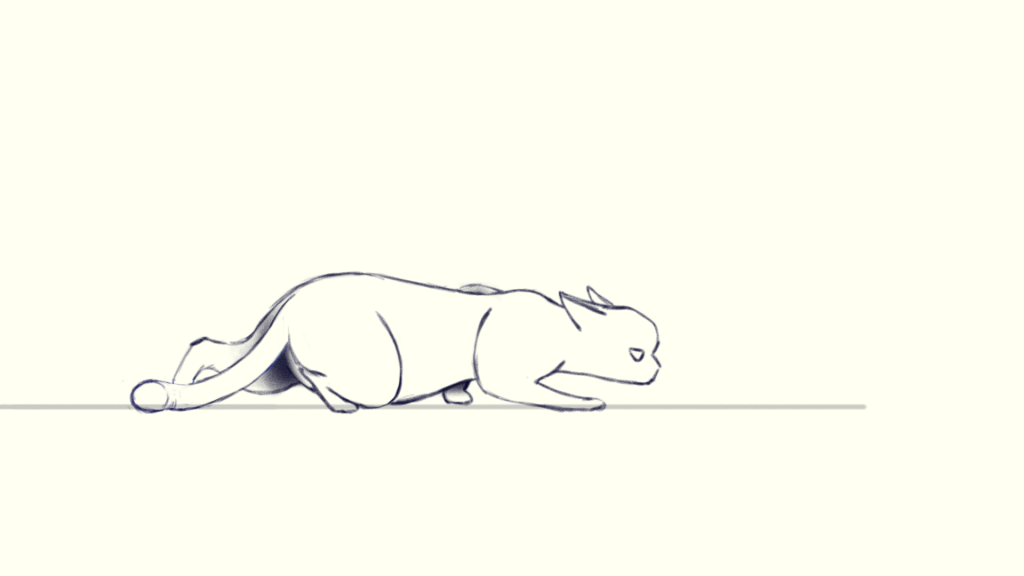
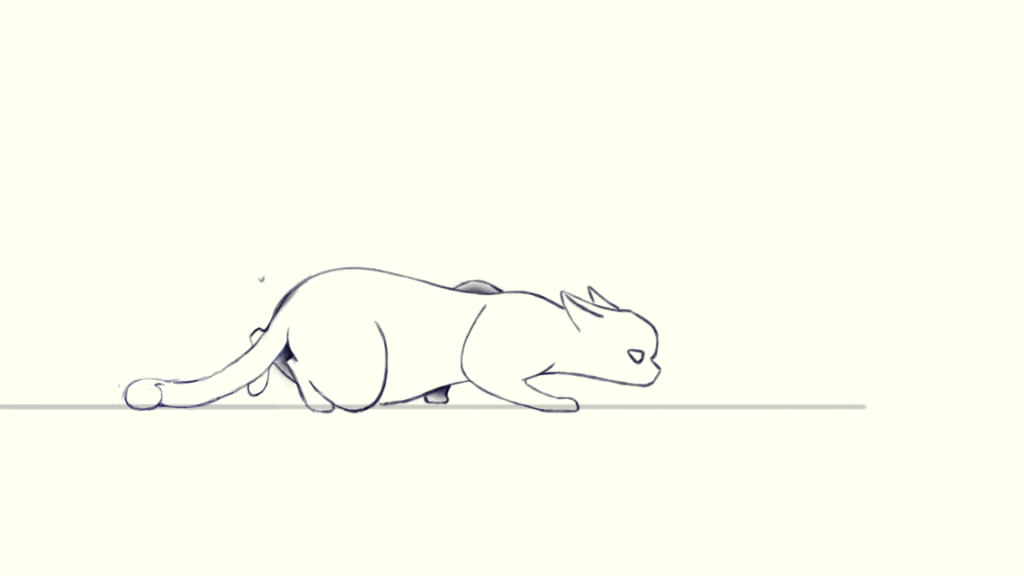
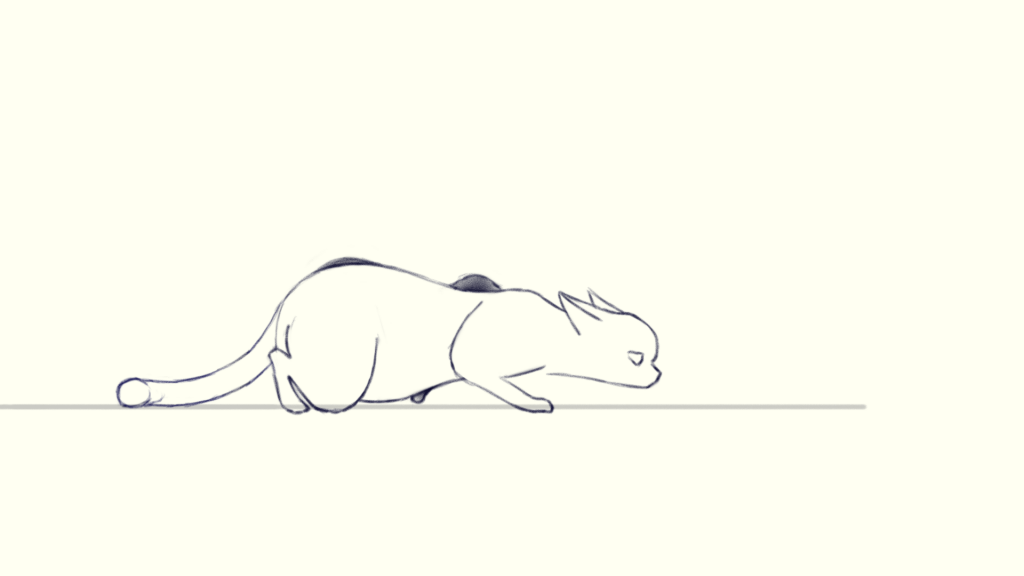
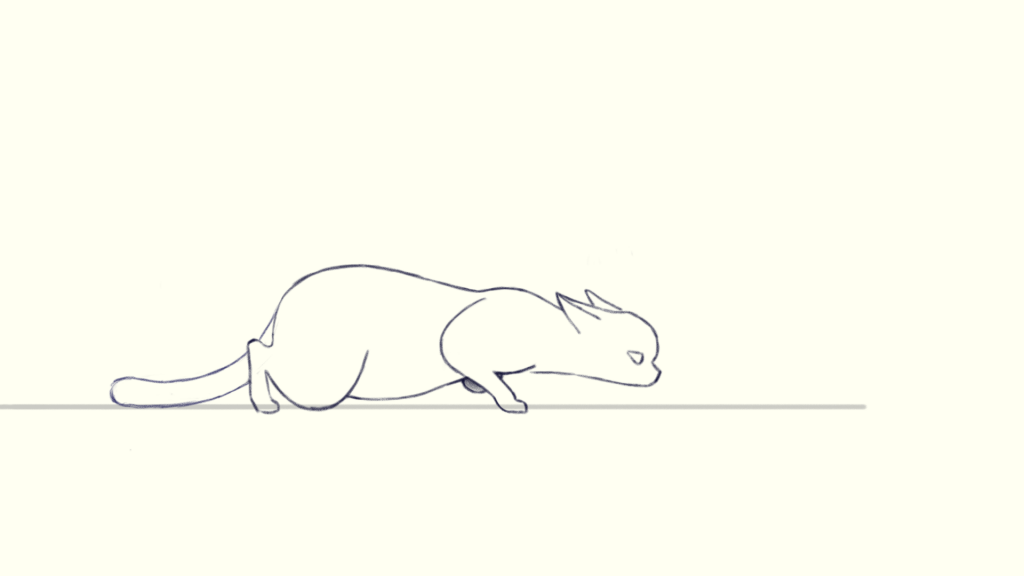
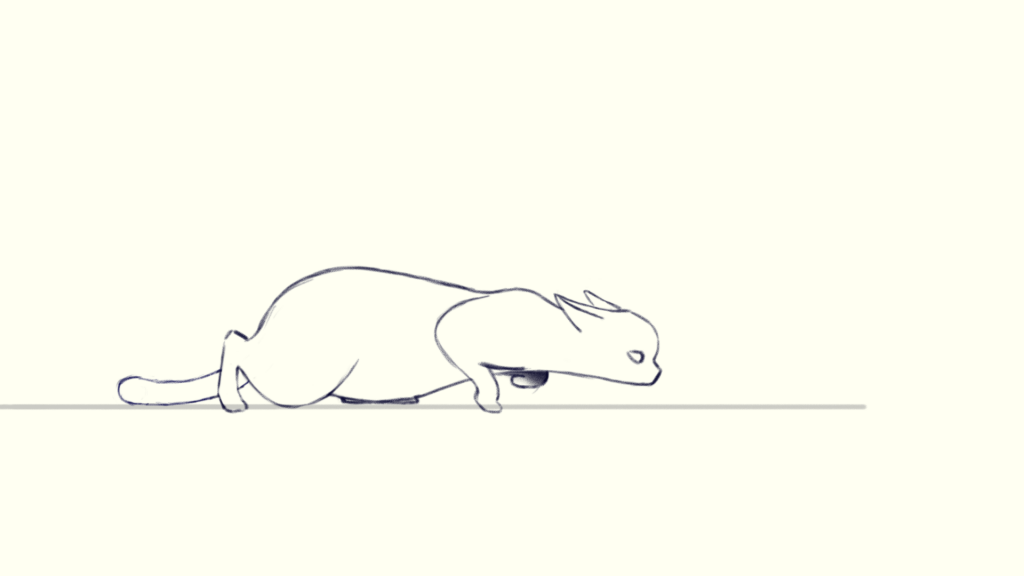
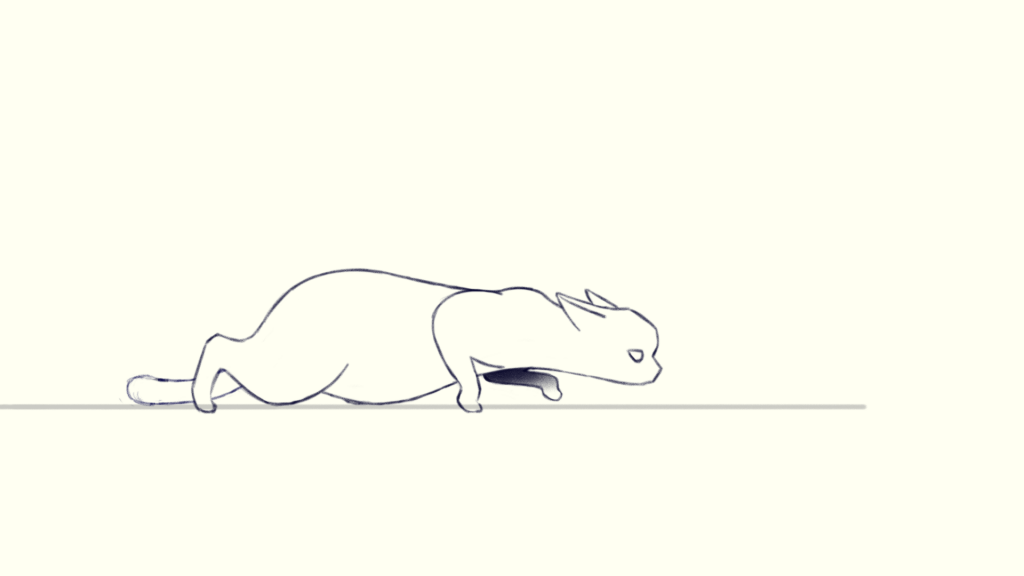
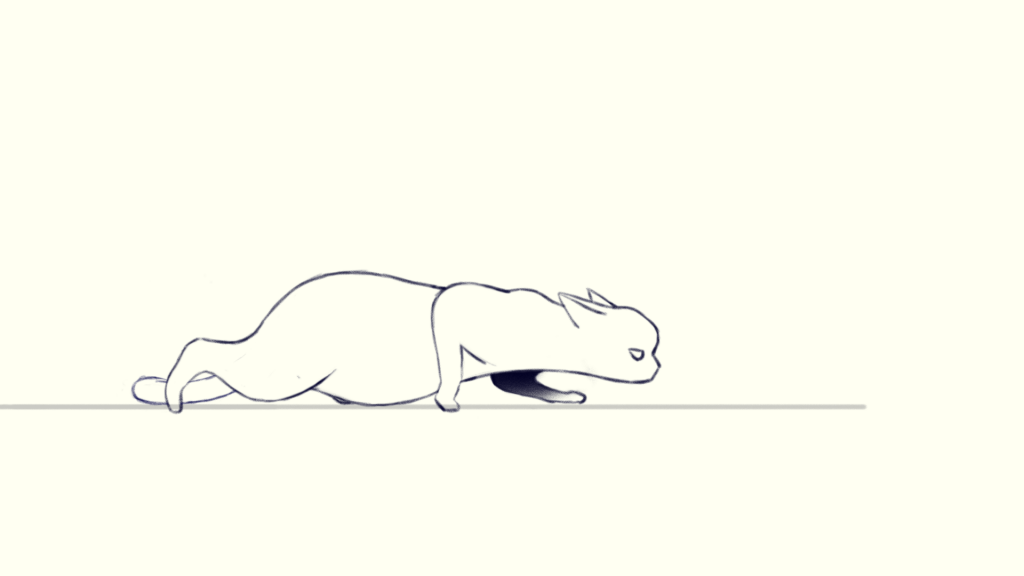
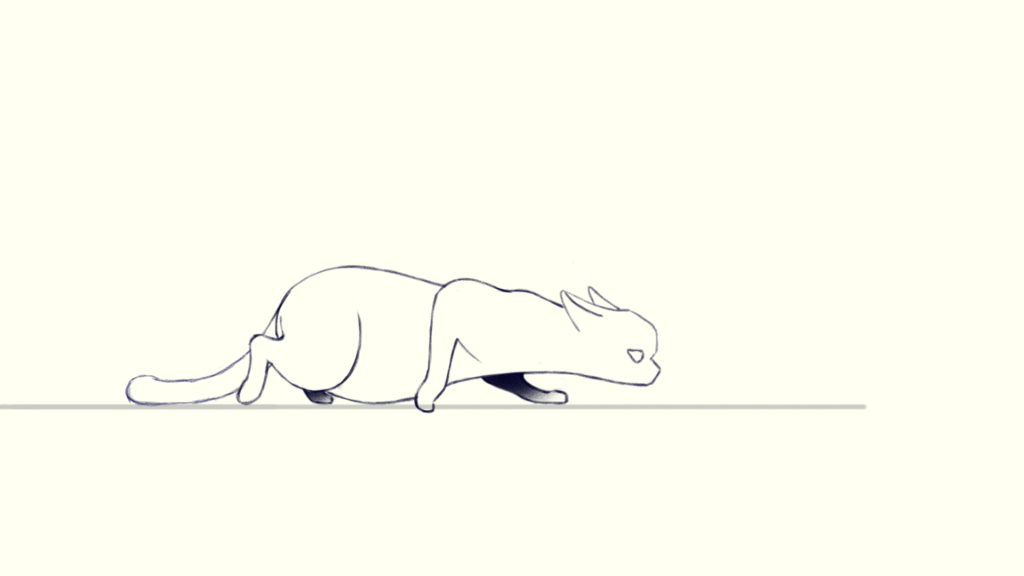
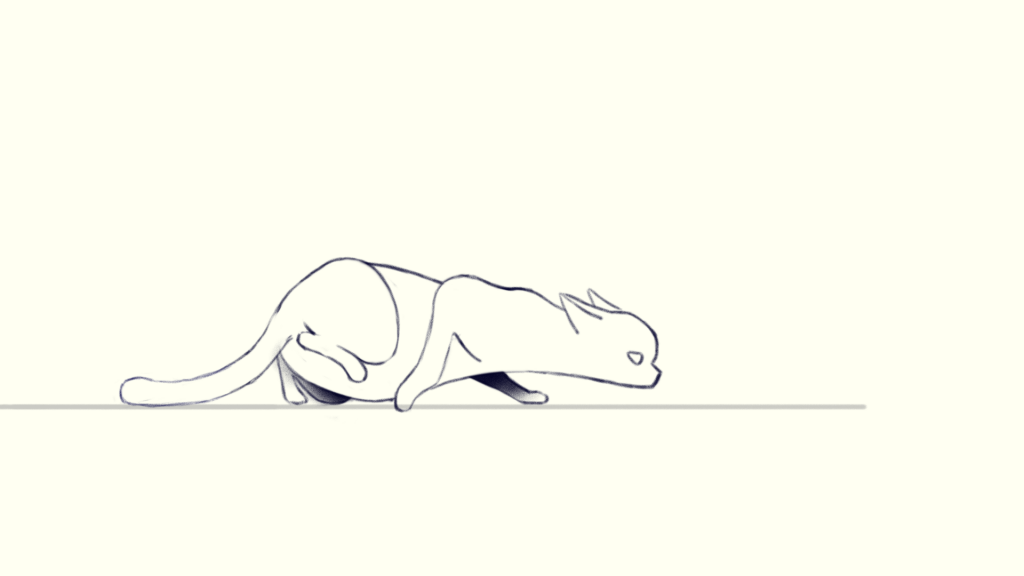
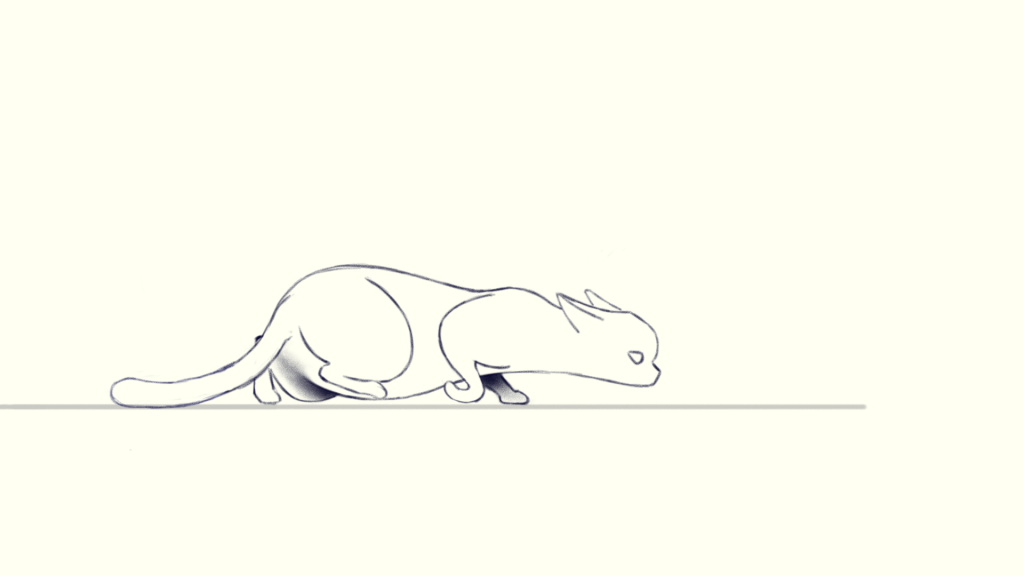
While I do my quadruped walk practice, the first thing comes into my mind is to find the rule and reference, then follow the twelve principles of animation and consider the cat’s movement patterns to animate it.
Rule
After carefully reviewing the “2025 Quadruped Walk” PowerPoint, I decided to follow the “Basic Animal Walk Pattern”:
One step is defined as taking one front leg forward once. If it takes 6 frames, I need twelve frames to make a circle.
Reference
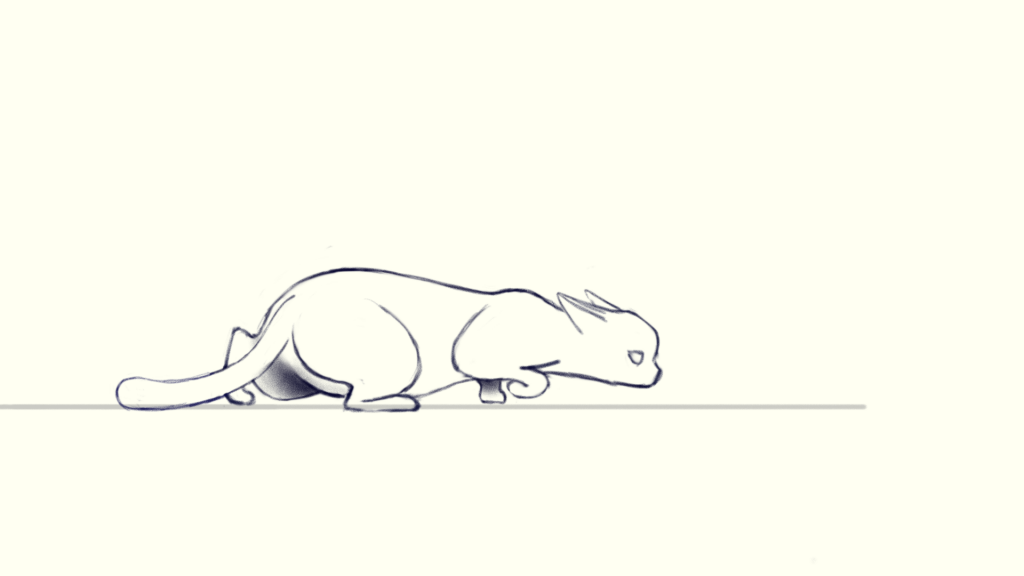
I had done some normal animal walking before, also inspired by the powerpoint, I want to do some special walking like tiptoeing – the preparation stage of hunting. (Mostly because I tried to do the trotting but failed…maybe I will try it next time…)
The reference is as follow:
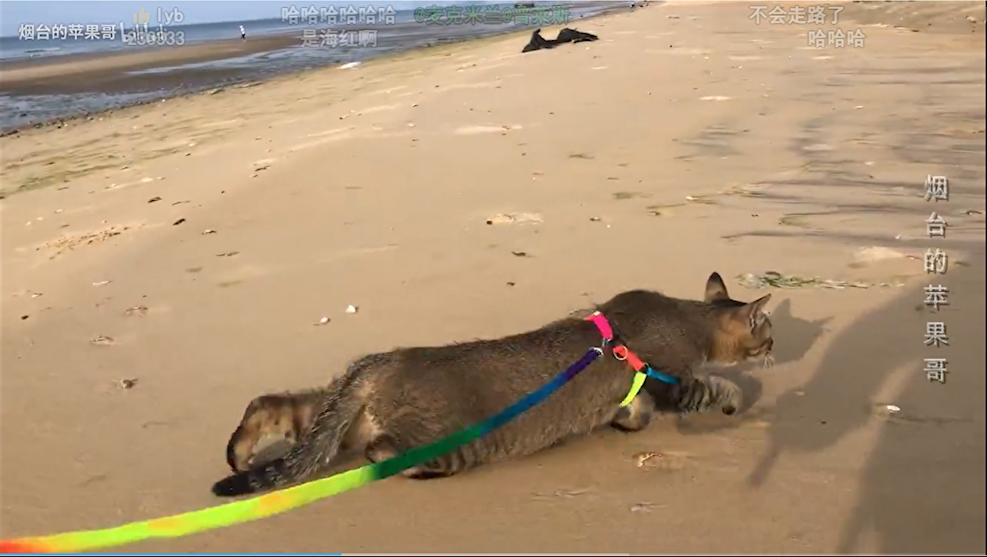
So the cat is very close to the ground and its legs are bent and stretched very severely.
Bone Structure(Squash and Stretch)
I choose to start from how the cat’s head, ribcage and pelvis moving. Because the head, ribcage and pelvis have no distinction between left and right, the .
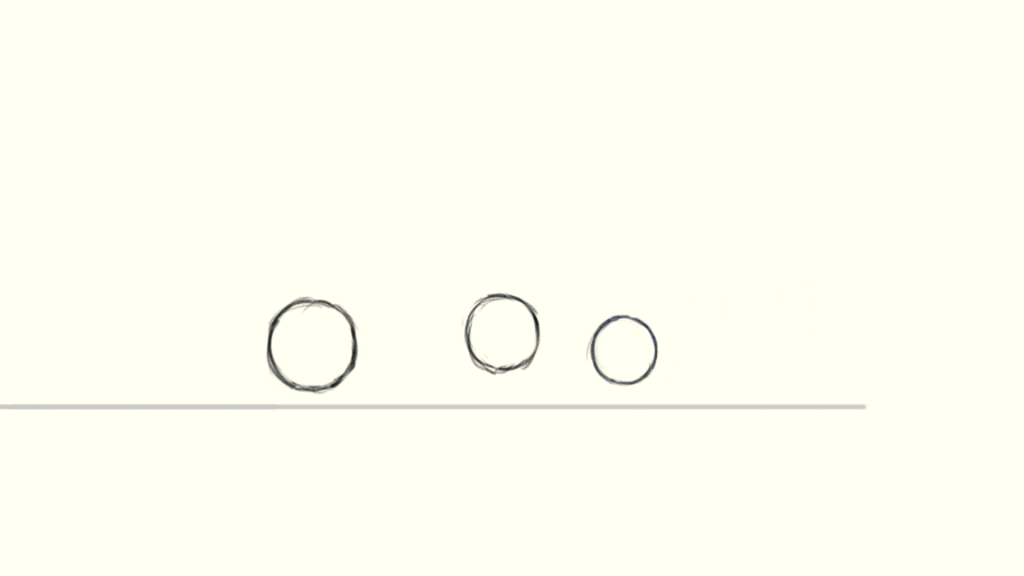
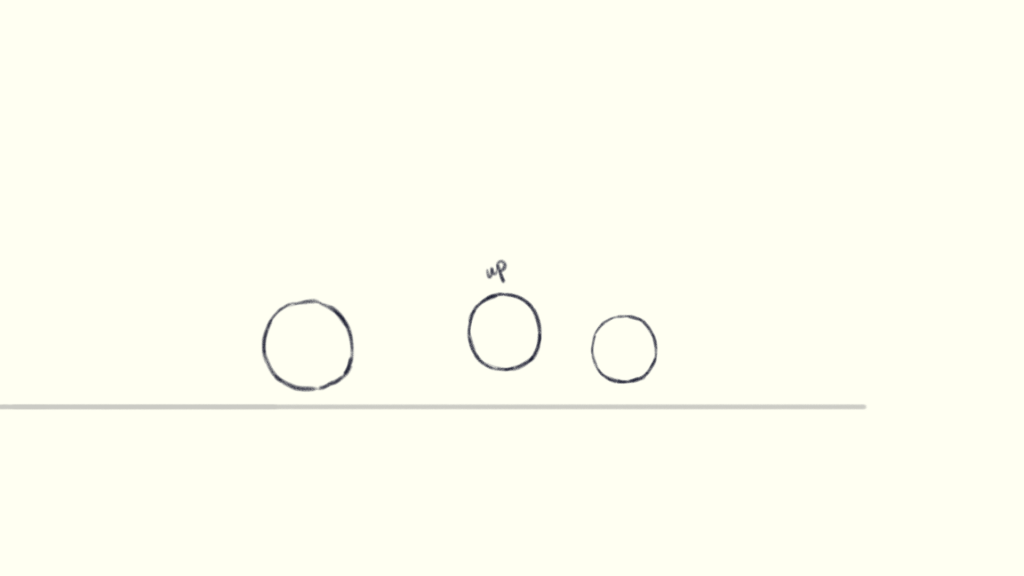
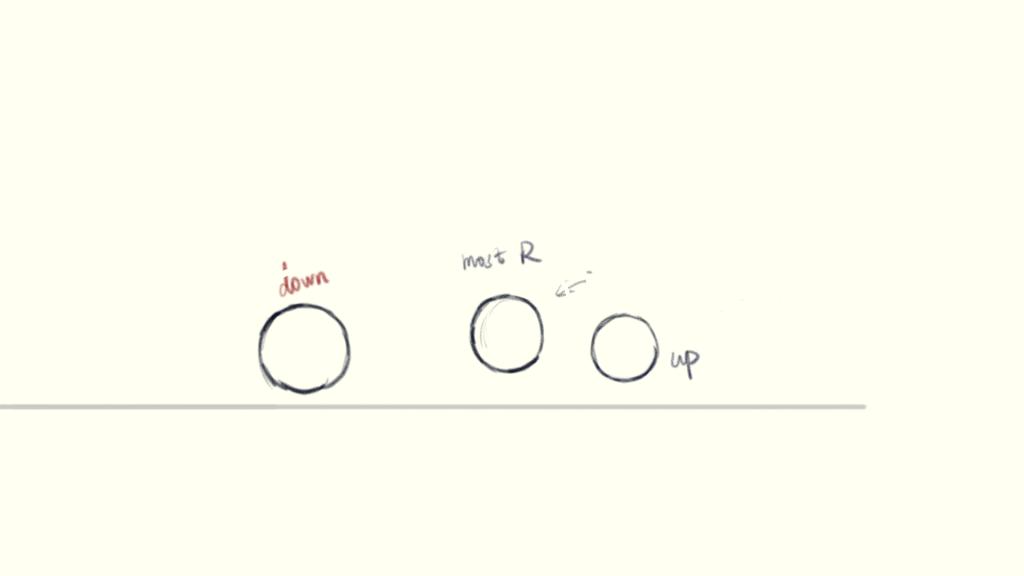
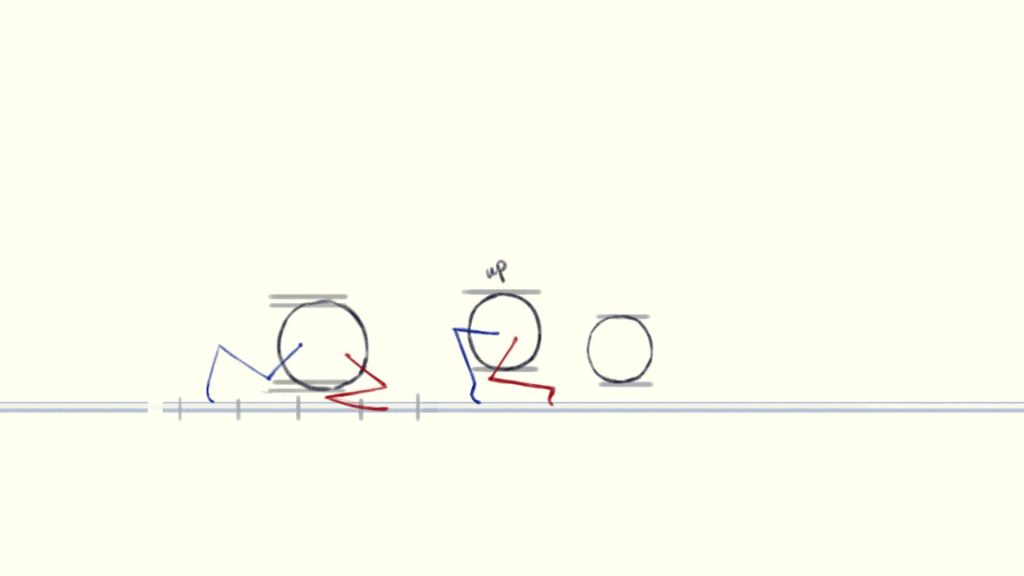
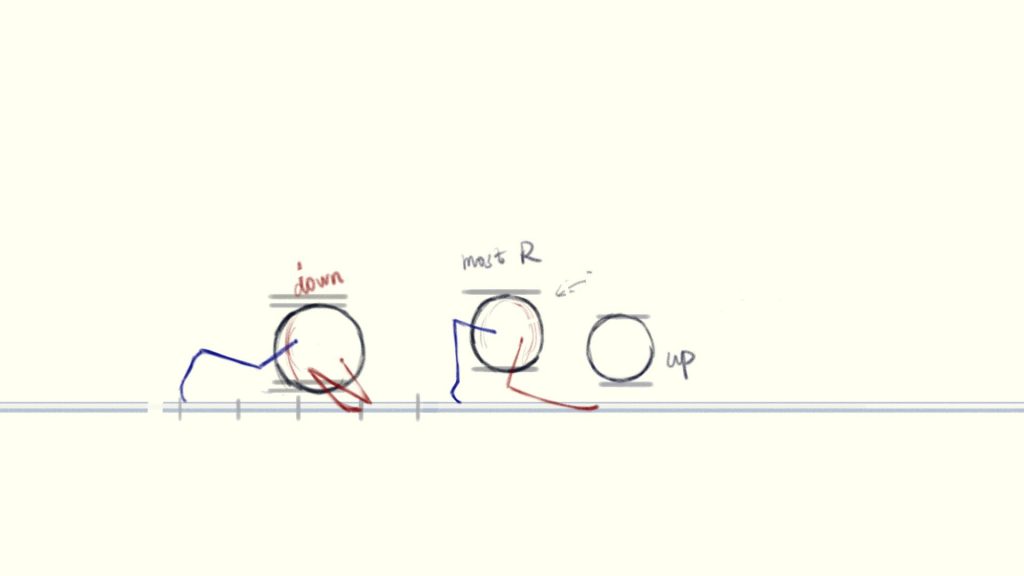
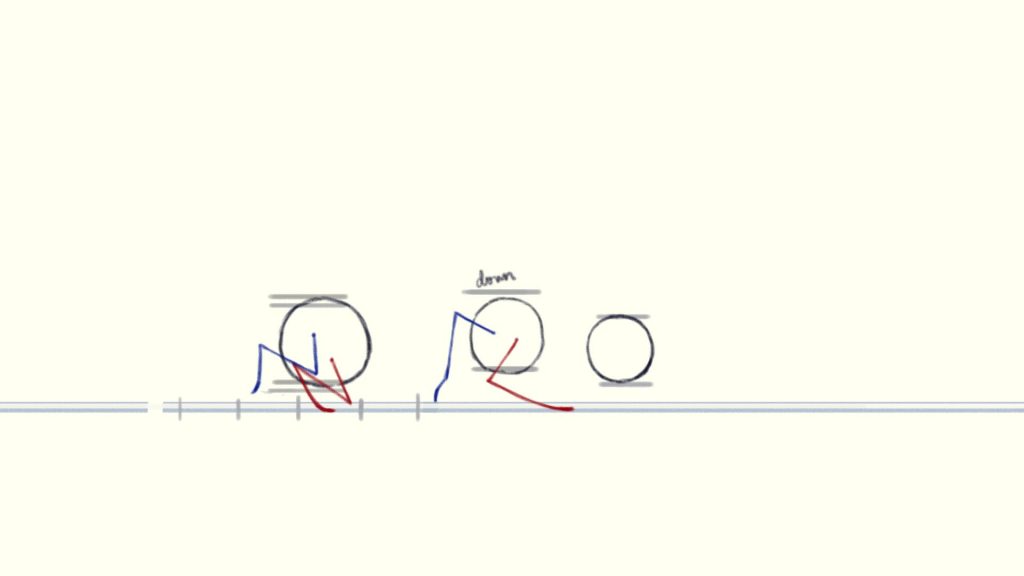
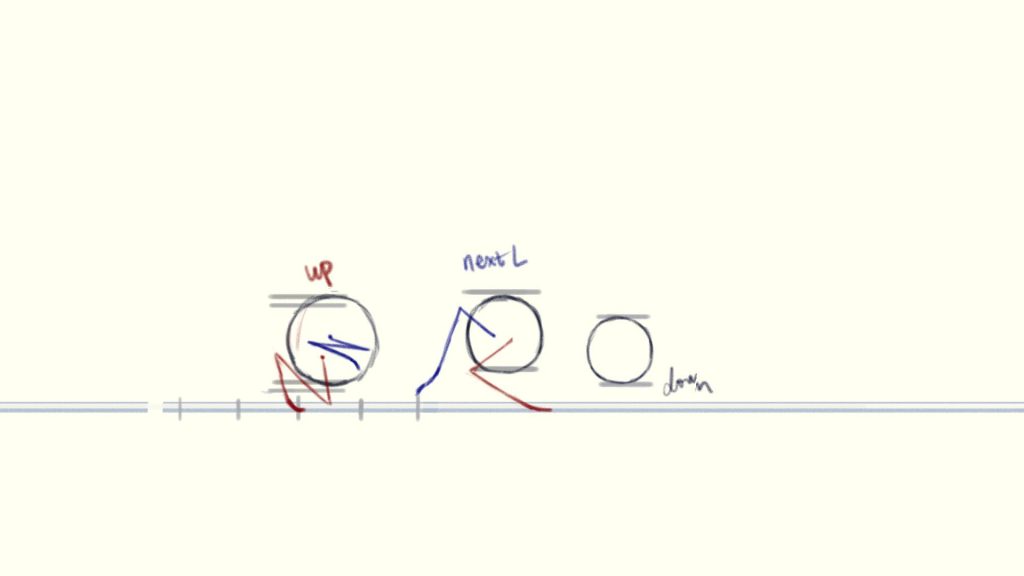
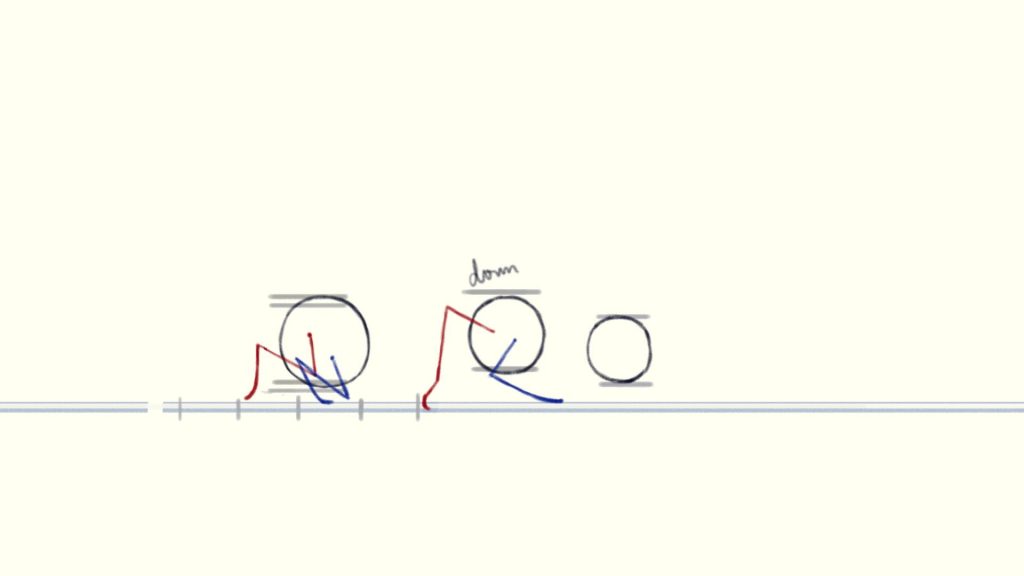
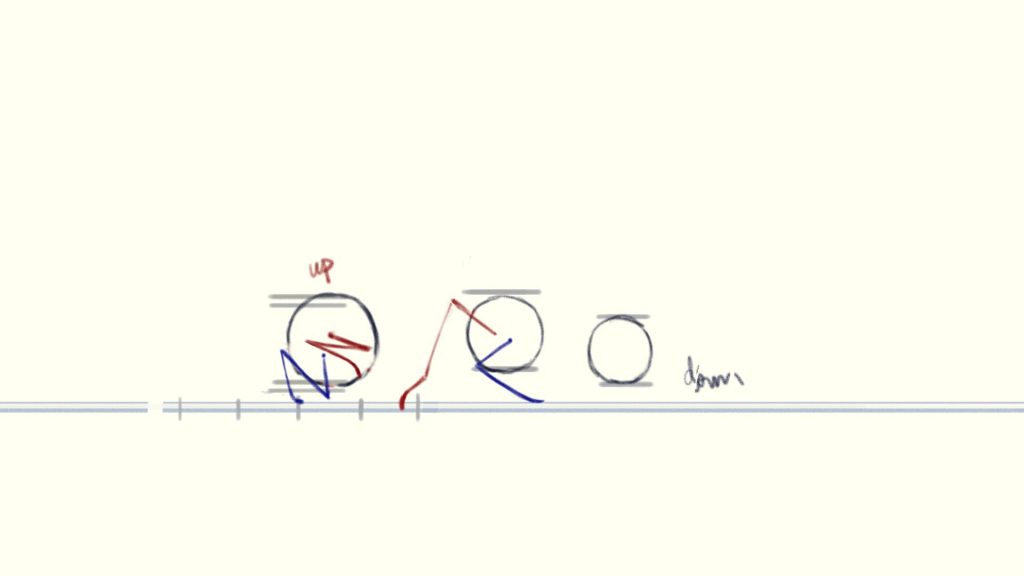
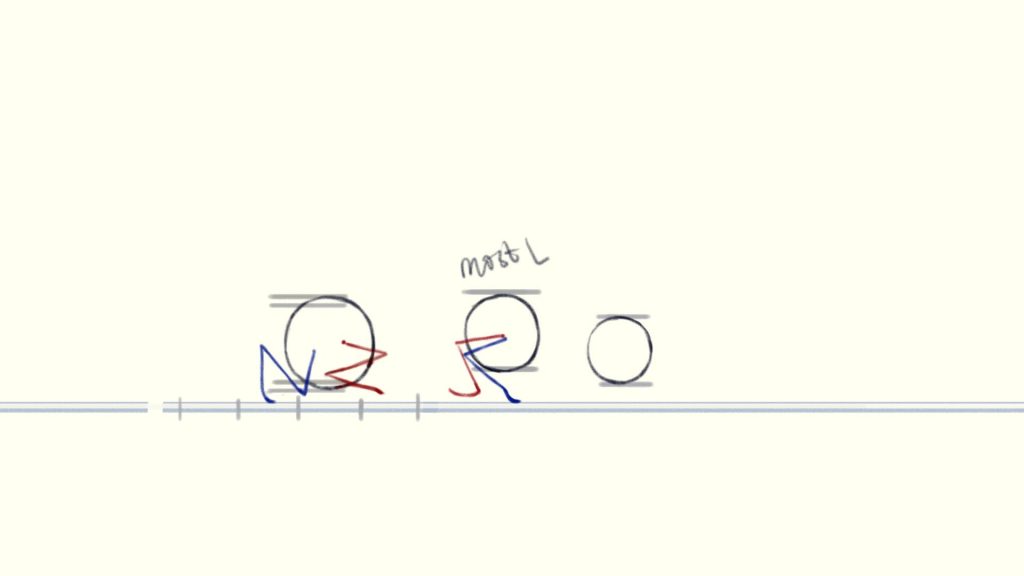
To make one step, the ribcage will have one highest point and one lowest point. As the rule shows, I take frame 2 and frame 4 as the highest point and one lowest point. This also suits the pelvis. I take frame 3 and frame 5 as the the highest point and one lowest point.
Because the legs are bent and stretched severely, the body should be squashed and stretched during walking. After observing the reference in detail, I noticed that when one of the cat’s hind leg stretches backward and the front leg is ready to take a step, its body is stretched to its longest length, which is frame 3. So I drew the ribcage furthest to the left in frame 3 to show the body stretches mostly. Correspondingly, the ribcage should be the furthest to the left in frame 6.
Another way to draw “squash and stretch” is to divide the ribcage and pelvis into separate parts. In the frame(or the next frame) where each part reaches its highest point, move it righter, and in the frame(or the next frame) where it reaches its lowest point, move it lefter.
The head is just move up and down due to animal head stability.
Legs
To draw the legs moving, just follow how the ribcage or pelvis move. Draw another line to show the perspective of ground, two side legs will walk on diffetent lines.
The secret to determining where the foot should be placed in each frame is: First find the two frames where the foot extends the furthest, and then divide that distance evenly according to the number of frames in between. (Some video said the secret to animate is timing and spacing, well I may think it’s math.)
Ears and Tail(Follow through)
The last thing is to add details like ears and tail. Just follow how the head or pelvis move and add a little bit of lay back, then you will get a tiptoeing cat!
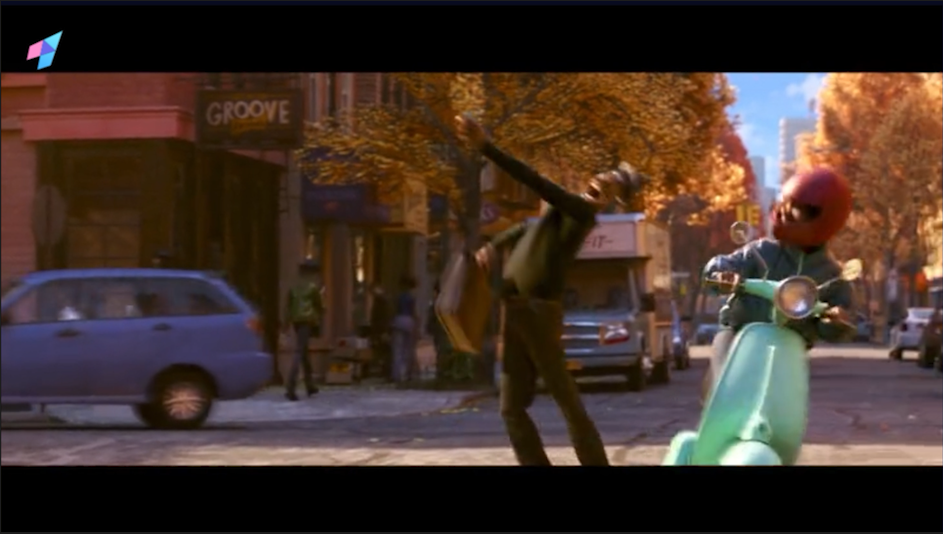
The clip I choose is a scene from the beginning of the movie “Soul”. (Well the movie is incredible…the clip I chose is a little bit long so I just premiered it and kept only the parts that attracted me the most.)
I will select the most representative segment and analyze it based on the twelve principles of animation.
Analysis-The 12 Principles of Animation
Squash and Stretch
The squash and stretch rule is not very obvious in real people model. Like the below frame, even it’s the extreme frame it’s still close to invisible.
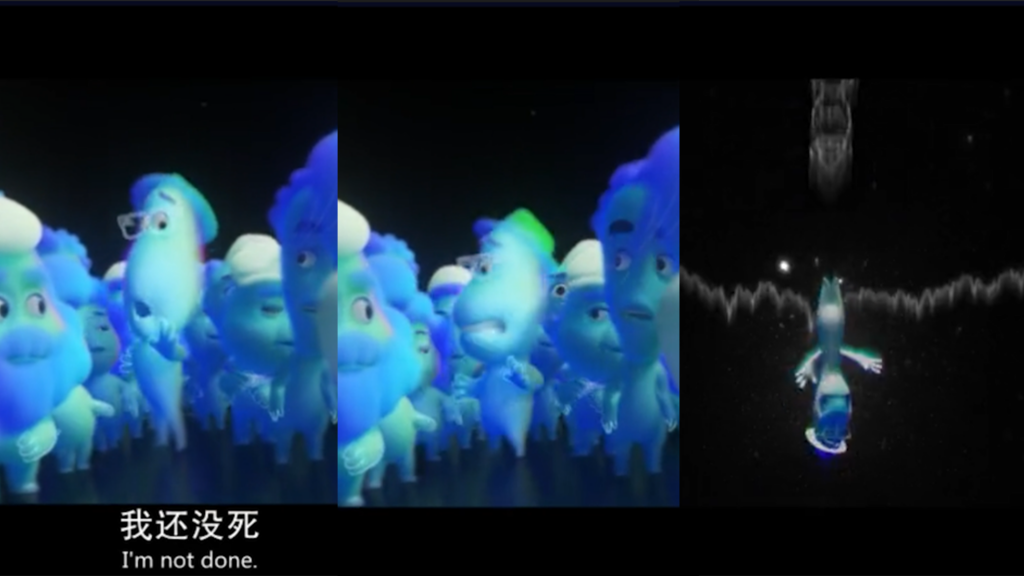
But when the character turned into the soul form(the aerogel form), the squash and stretch is more clear——the stretched body can be one-third taller than the original body or even more!(still control to keep the body’s volume constant) This strategy demonstrates the flexibility of the soul material.
Yet still this change is hard to notice because it is fleeting. I can only notice it by watching it frame by frame.
Anticipation
The anticipation happens more often when the character does some actions but not talking. When the leading man starts to walking, there are many aniticipations to lead the audience to see what movement happenes next.But when he starts to talking, he just open his mouth straight away.
Like this clip below, the man dose a lot of anticipations such as:
Raise his arm before cheering.
Raise his arm before the arm drops.
Turn his head to the side before he walks to the stroller
Look at the electric bike before he hides
Staging
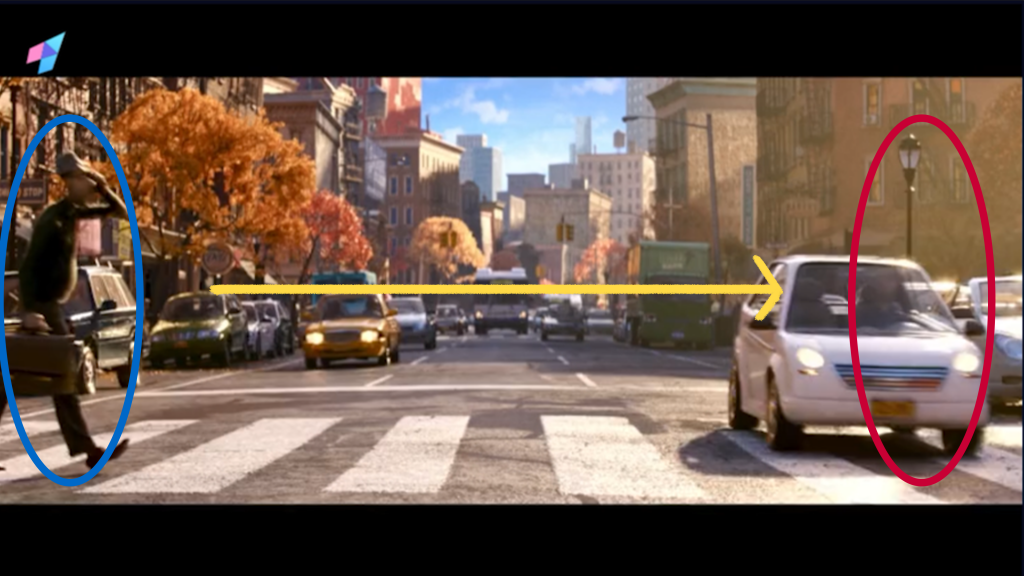
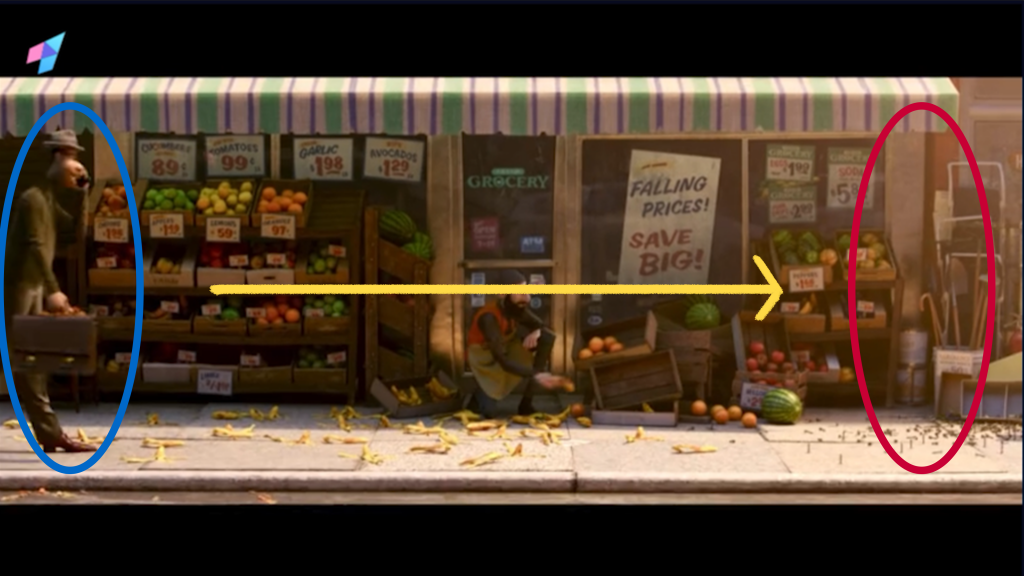
I observed two ways to manage where the audience look at while switching the shots.
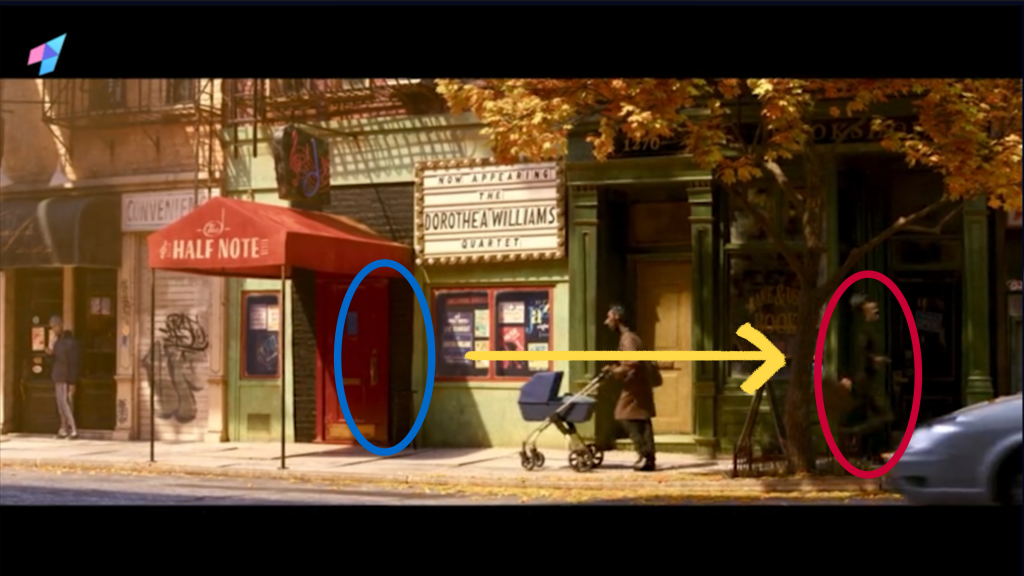
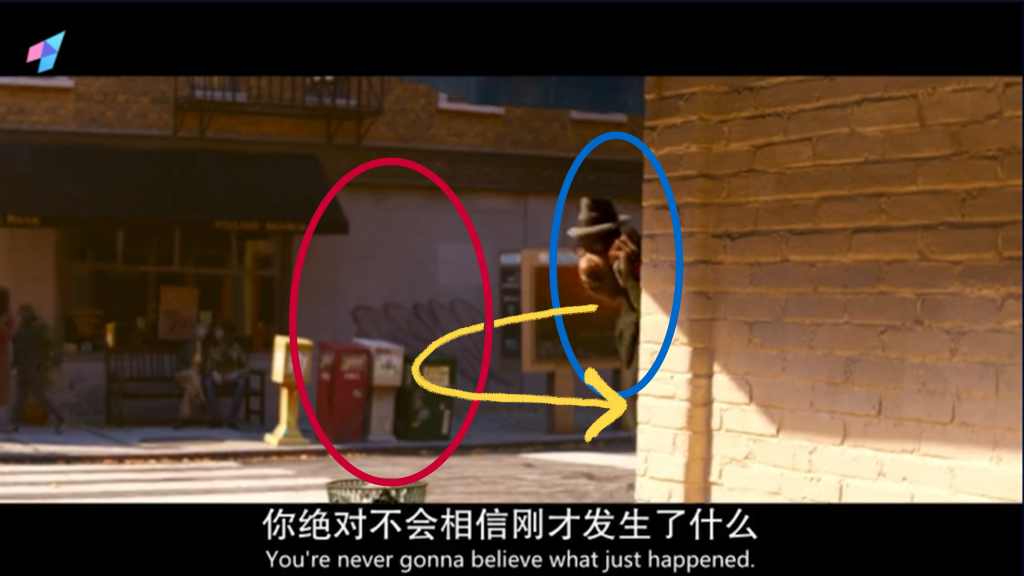
Well the most common way(also the way I know) is to keep the moving part ends and starts at the same place.
(The blue circle is the position where the charaster is standing at the beginning of the shot, the red circle is his final position and the yellow line is how he moves)
Like two adjacent shots above, the character moves to right when the first shot ends and moves from the right when the second shot starts.
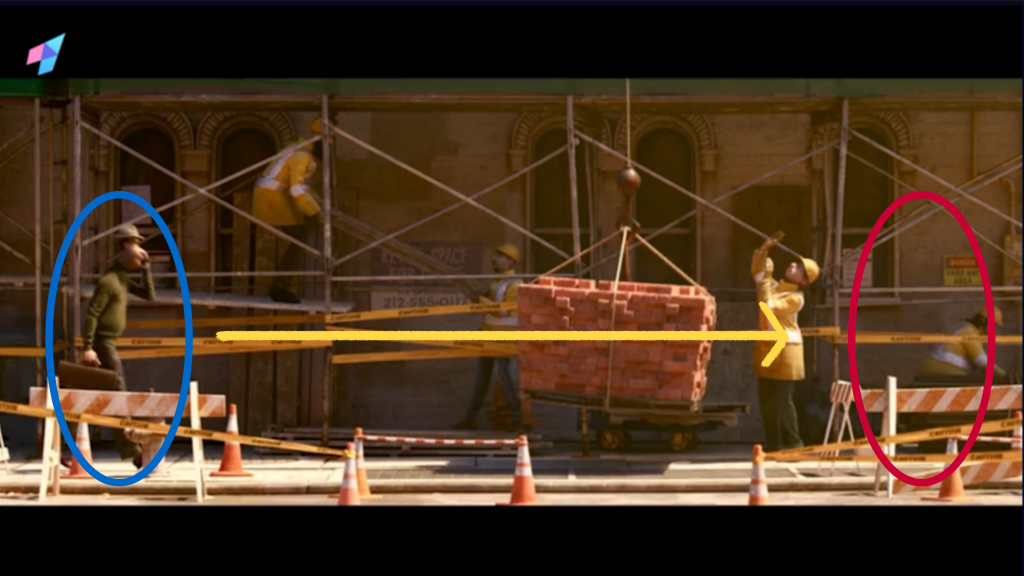
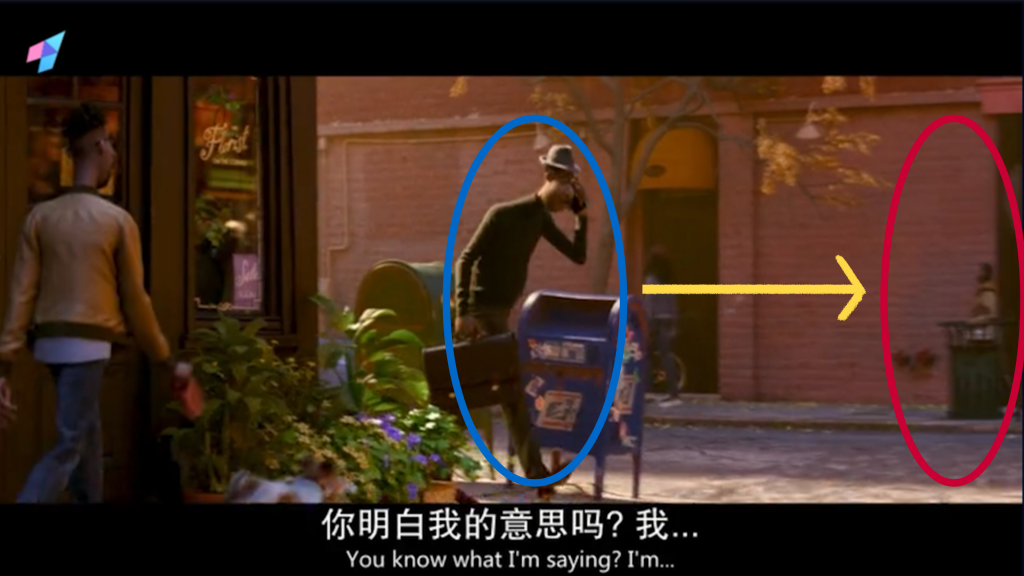
The another way applys when the character needs to go some direction for a long time, such as the group shots which the character walks several street blocks. So the character just enters the frame from the left side and exits from the right side, and next shot repeats this process until finish. The example is as follow:
Another interesting thing I observed is when lots of things move at the same time, the main character must move the most to attract attention and the rest just move very slightly. This solved my problem of wanting part of the background characters to also be in motion, but not knowing how to arrange it.
Straight Ahead & Pose to Pose
Obviously it’s mainly pose to pose because it’s a 3D movie. I think the frame by frame will be used on the follow through or special effects like water.
Well the simulated work still keeps going. I may think the ending depends how long I want to continue helping and it’s definitly a wonderful project. It’s just the right opportunity to find what we are interested in mostly and take a look of how people cooperate. The workload of designing the background far—— exceeded my expectations. I remember the redesign of new perspective took me a whole week to finish…the new parts that need to be redesigned just poping out constantly. But it’s still so——funny! I can’t help but draw a little more. I need to remember to allocate more time for the preliminary work(like character design, storyboard, layout) next time, such as the LIAF project next term.
The following are my work logs.
260309-Now
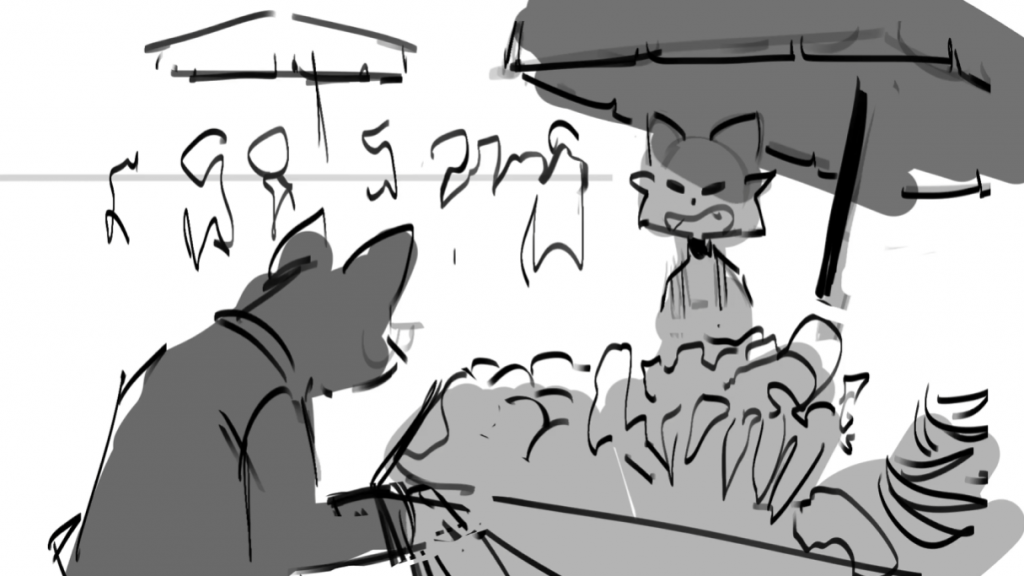
The feedback is to simplify the stalls and make it more Chile style.
260303-260308
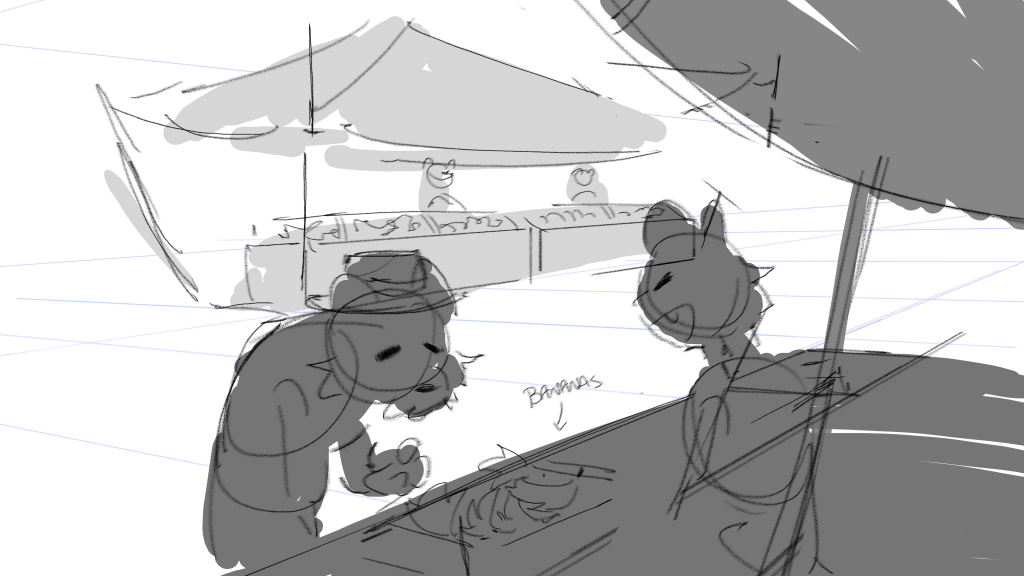
I got the feedback and needs to change the perspective to this:
(And put all the characters who have occupation standing behind their stalls.)
John also give me some guidance on character design: (Thanks John!)
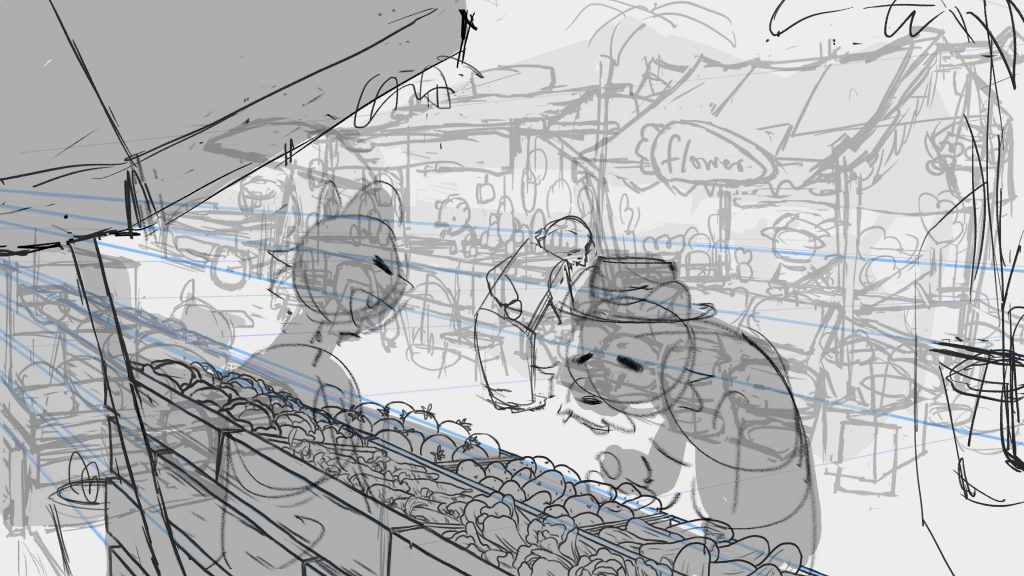
Back to the background, that’s a very good perspective. But considering next shot the cat falls from the right side, to match the focus of audience’s eyes, I mirrored John’s draft.
Also the erected tent seems too common so I re-designed the stalls they have. I add the plaque and draw the products they sell according to their jobs. The draft is as follows:
Also do some clean-up to see the final effects.
260227-260302
Choose some positions and design the characters. Not very much because I think I have been running too far in the wrong direction…so I ask John about some advices first.
And also the draft:
I put the designed characters walking around the street or buying something, but maybe it’s too complex to animate? Also there are too many things to move at the same time.
The most thing I considered during drawing the background is perspective. To make the background world convincing, and considering all the characters have different heights, I kept my attention on the horizon–“All things go through the horizon have the same height.” (I found it’s very easy to betray that law…)
260226
I meet John on M207 to talk about the next task. I need to finish the layout of shot 2 and the rest storyboard. The layout is about designing some background characters and stalls.
For the character design, I think of the economic conditions and culture background of the place where street market could appear to infer what kind of people will live around. (Obviously a billionaire will not live here.) So I make a list of all the possible positions which may suits this story:
Sports coach
Gardener
Fishermen
Electrician
Carpenter
Painter
Miner
Tailor
Shoemaker
Insurance salesman
Mail carrier
Farmer
260224-0225
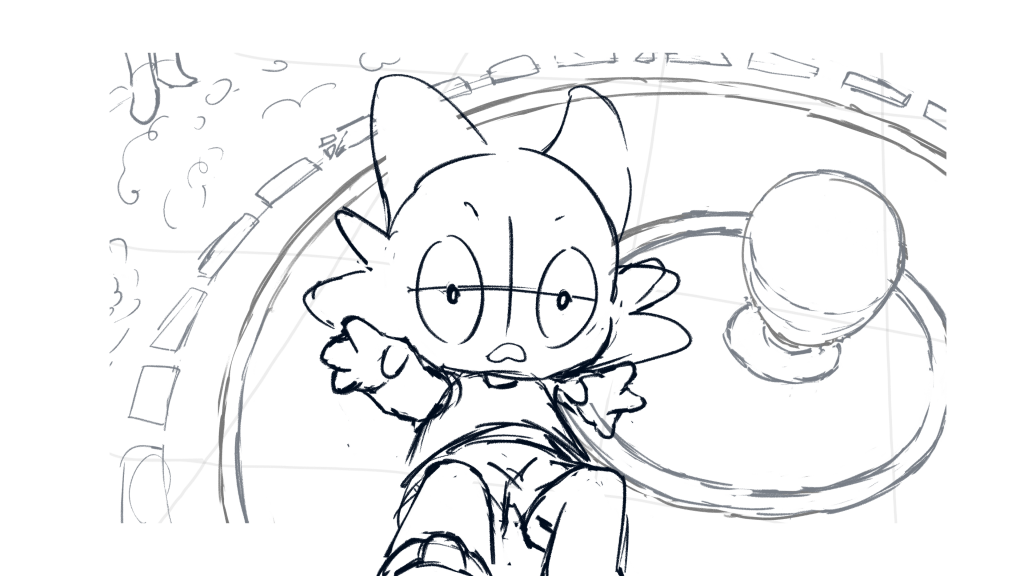
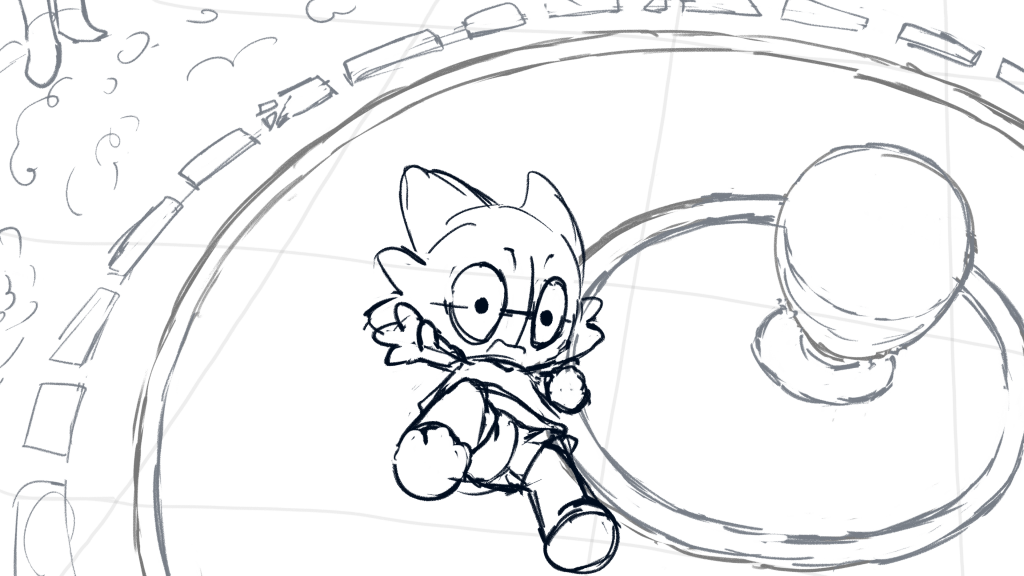
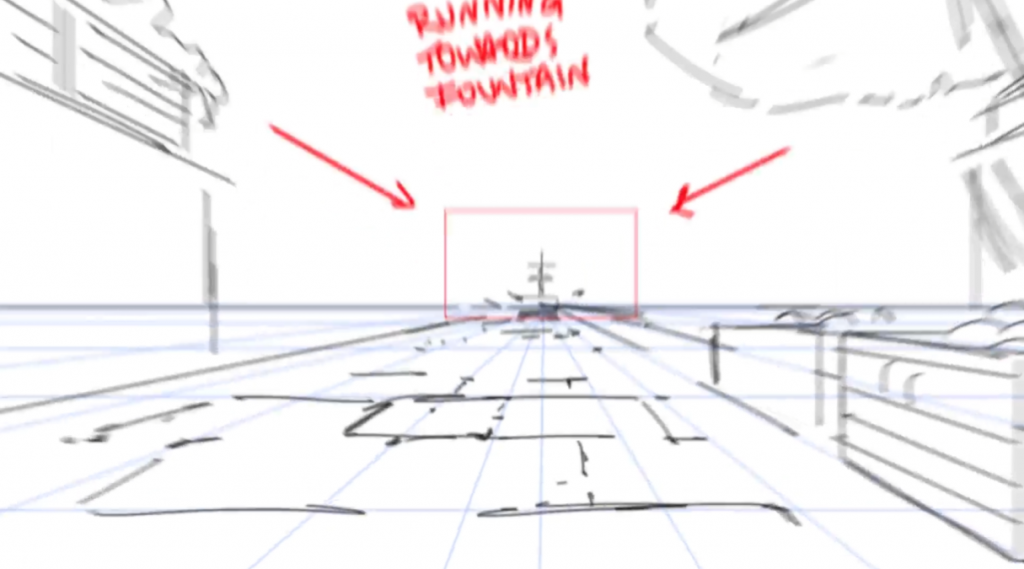
The first thing we decided to change is the running part from 01:08 to 01:18. I redraw the storyboard and put them into the video to see the effects.
(While drawing I was like:” The perspective is so easy! “, then draw a wrong line.)
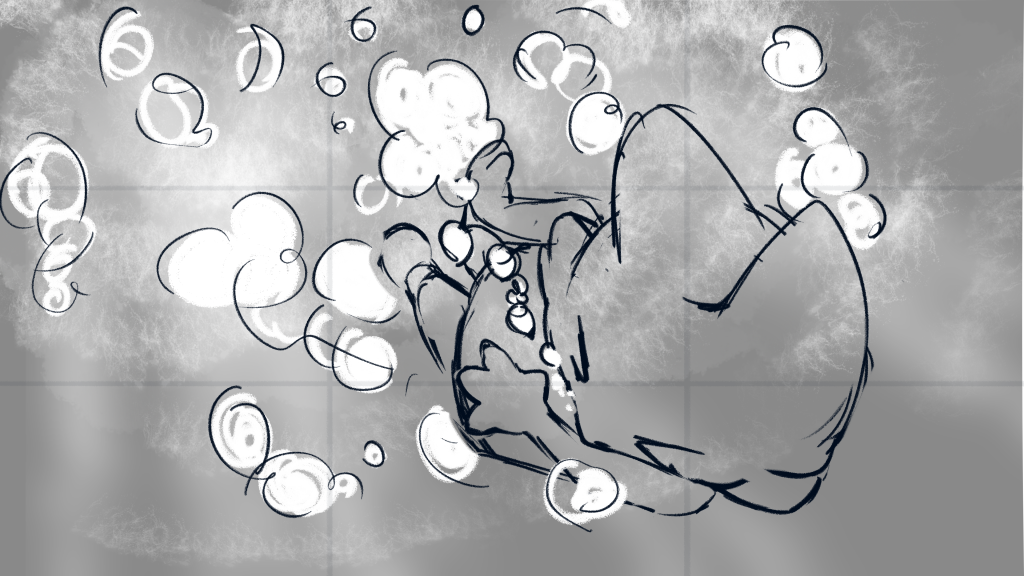
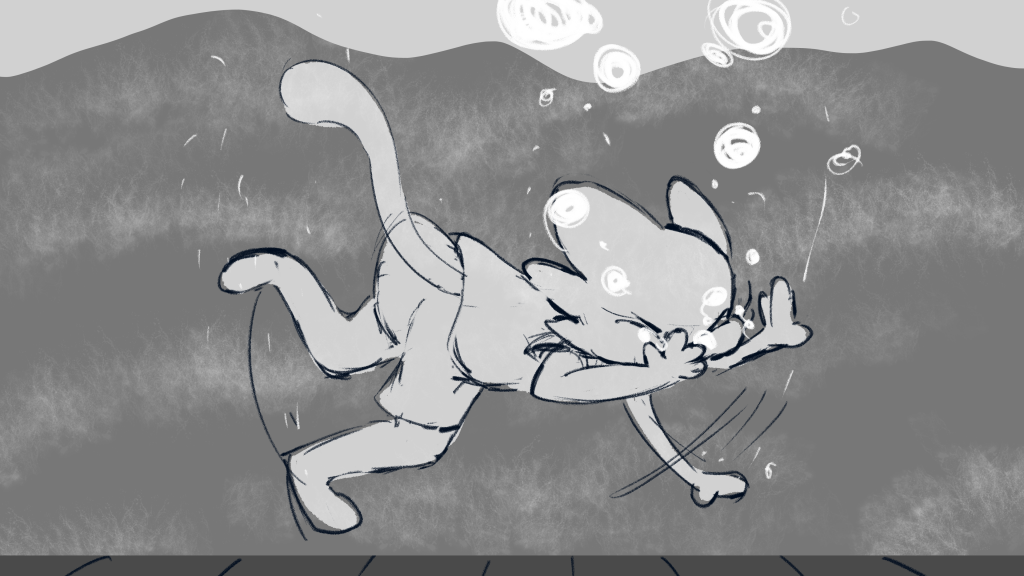
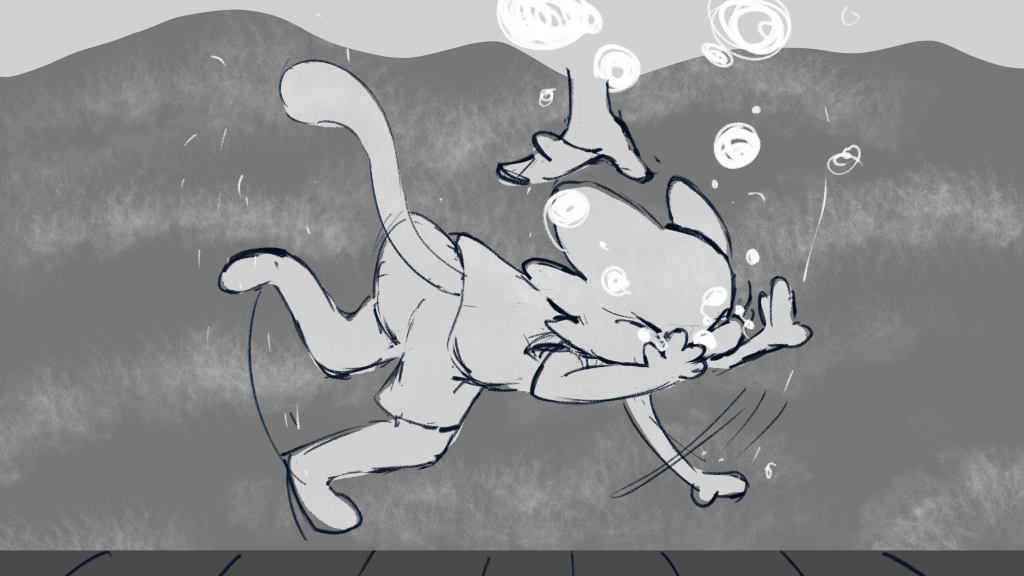
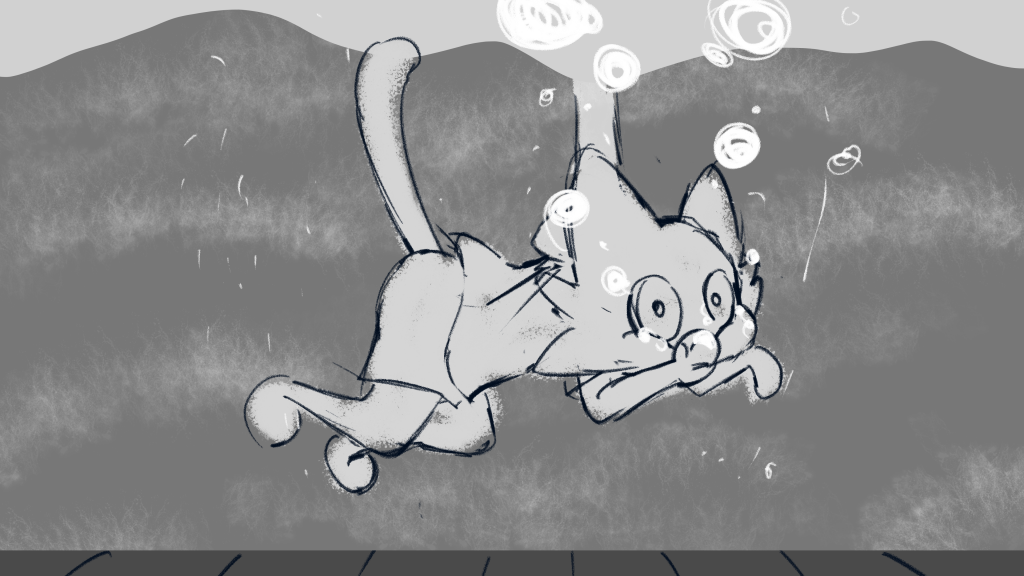
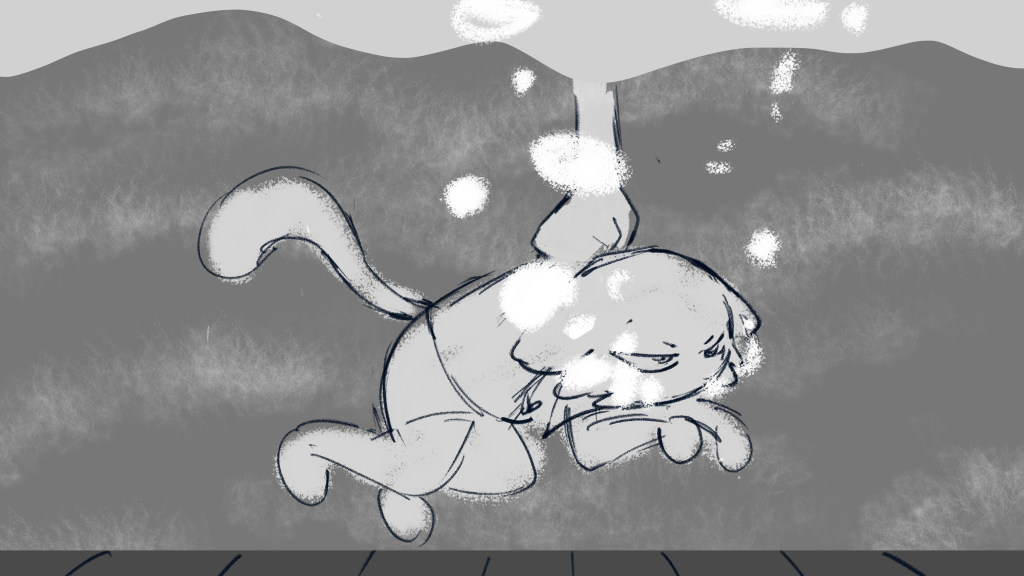
I gave John two versions. One contains the underwater part and the other doesn’t. John choose the first one.
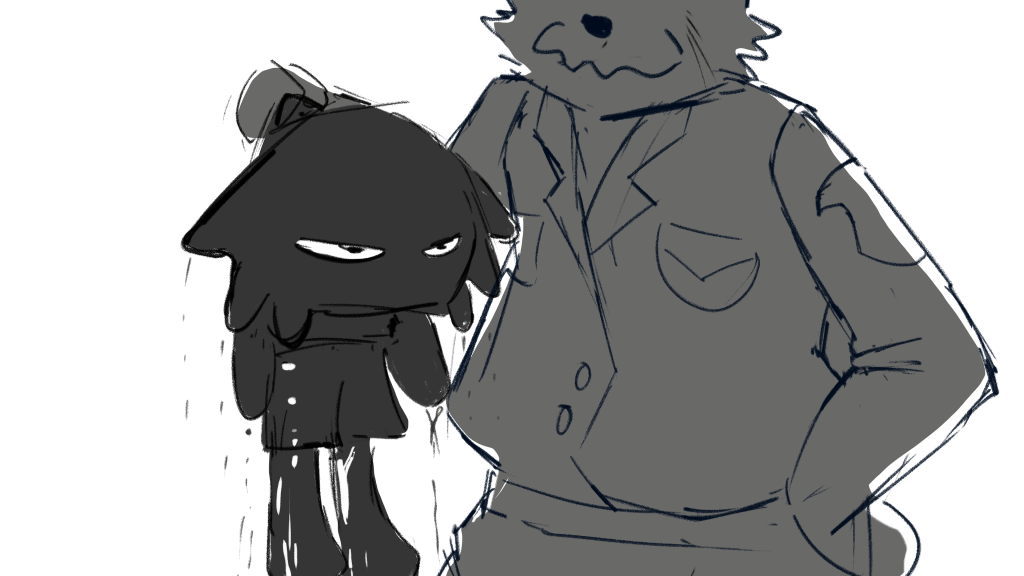
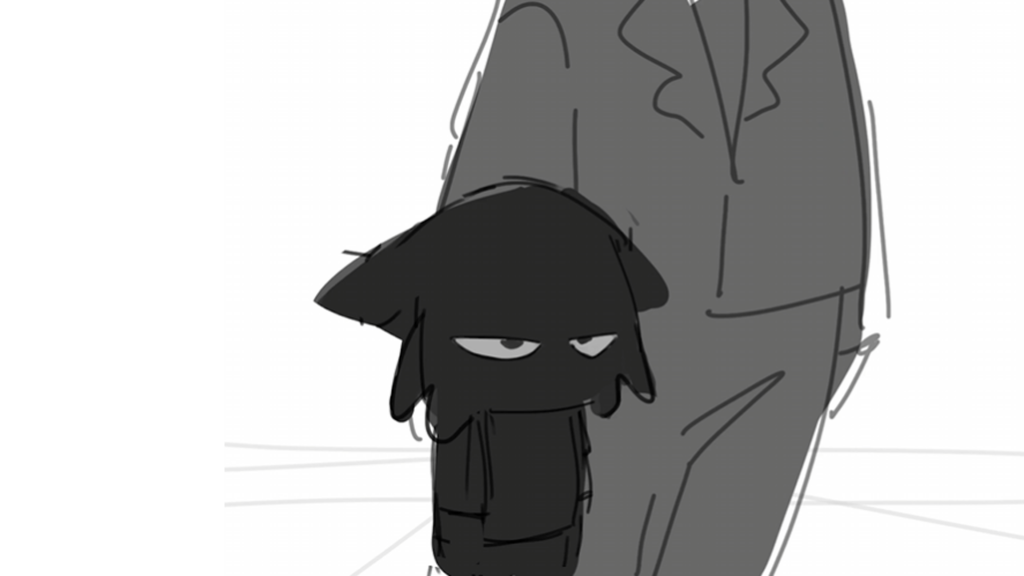
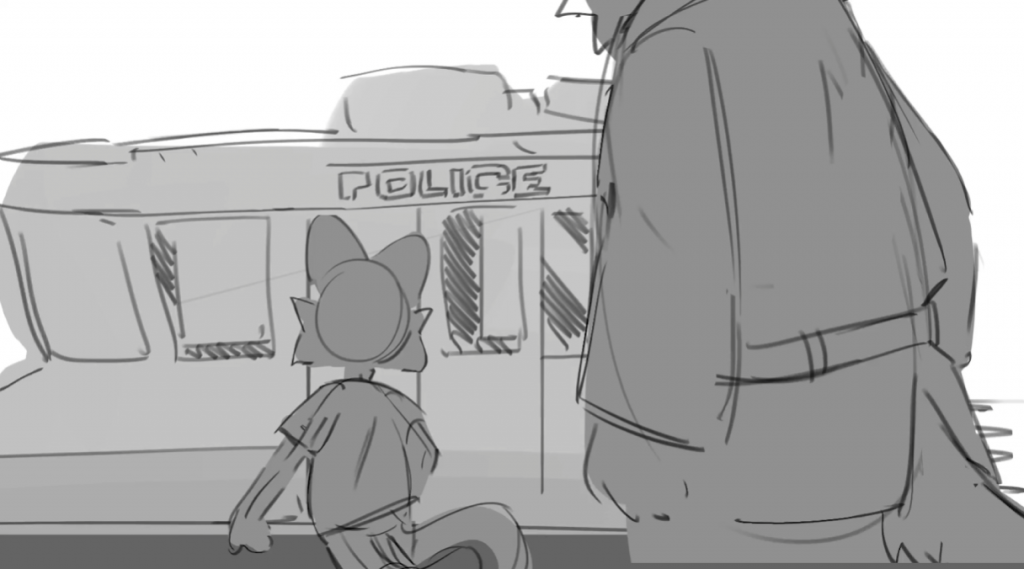
Also I think there may need one shot to reveal that it’s the police who chases the cat. John thinks for not adding too much on the background, he can add a up shot to reveal.
260223
John said he needs the background design, layouts, and some inbetweening on selected shots, so I’ll start from the background design.
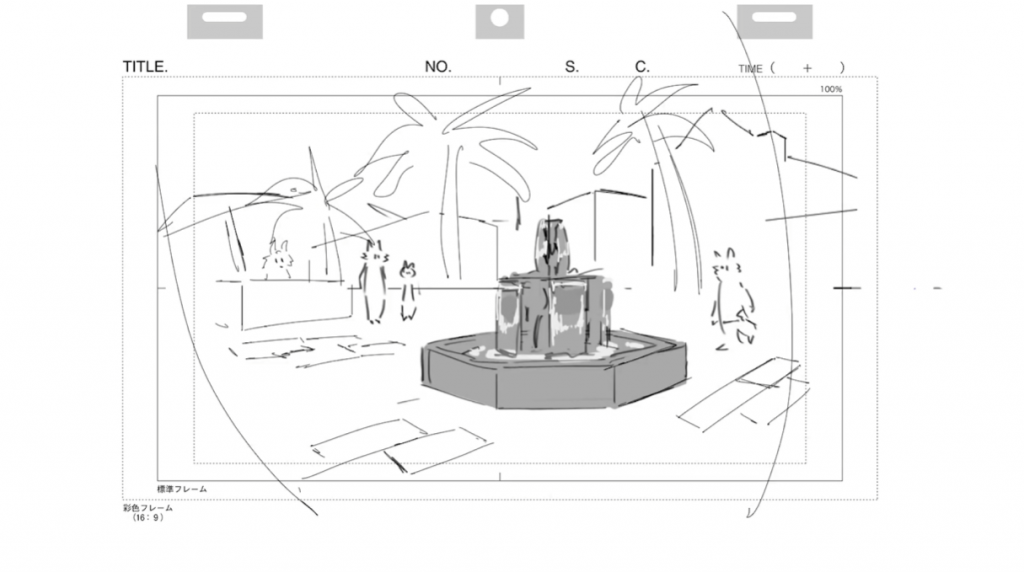
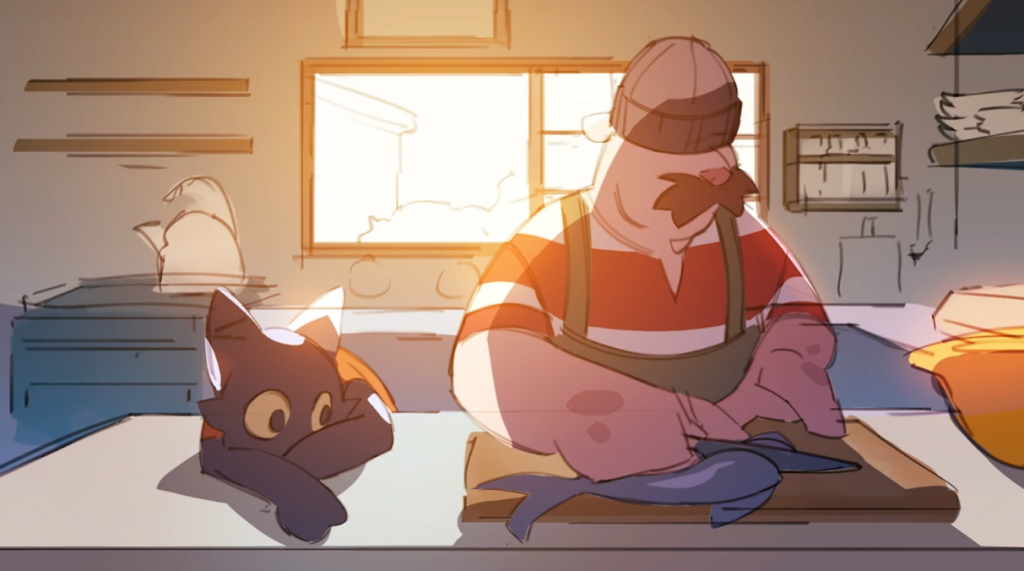
The backgounds to be designed are shown as follows:
There are about 17 scenes during the animation, I categorized them into the following types:
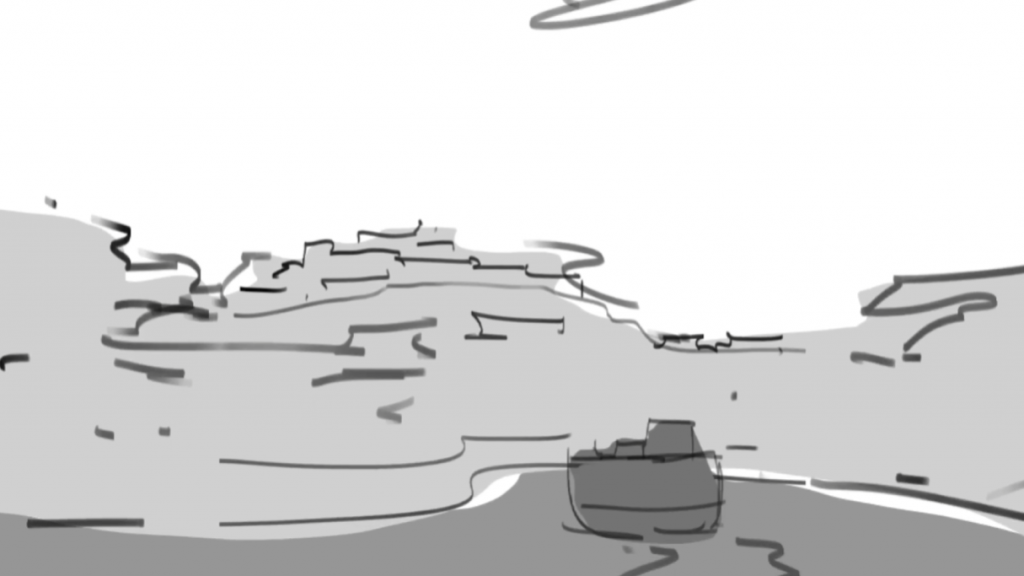
One panoramic view of a bay market;
One shot of a market stall(not the father’s one);
The father’s market stall and the street;
One pan of other stalls along the street(as the cat running);
The spring;
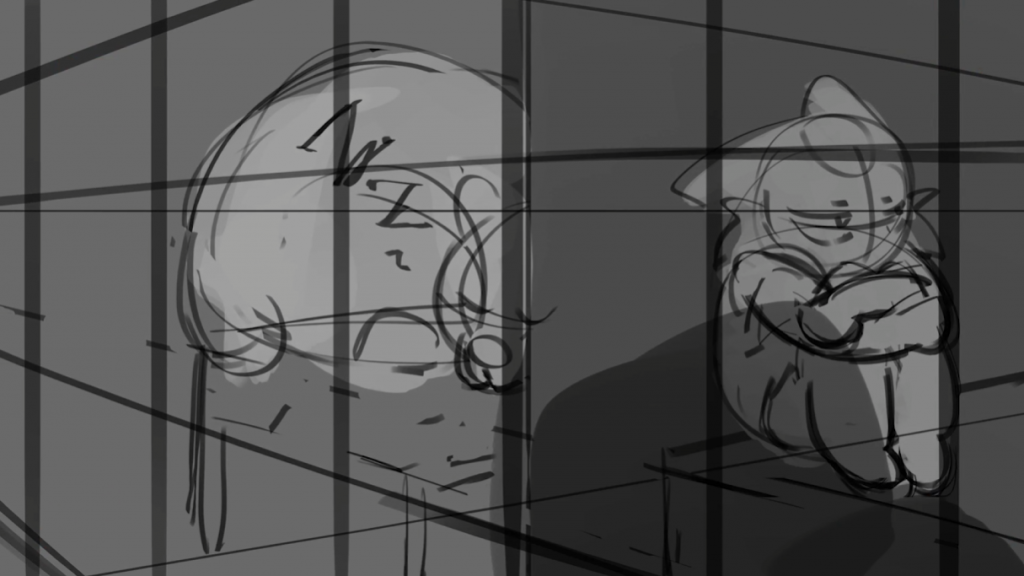
The police station and the jail;
The father’s house:
The cat’s room(varys as he grows);
The room dealing with fishes;
The fishing spot;
After talking with John, some of the background will be modeled by CGI, I’ll start from the shot 2 background, and refine some storyboard.
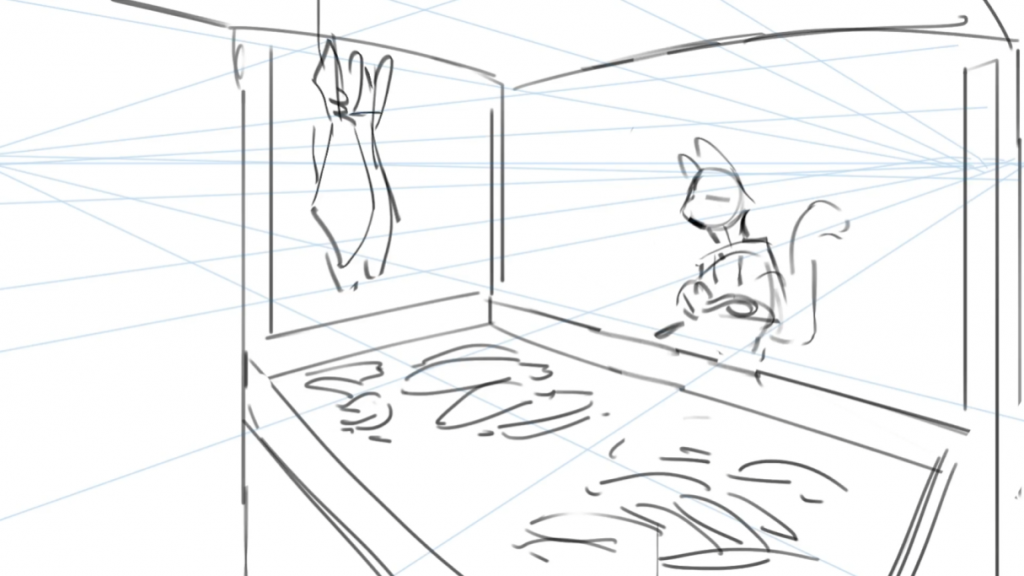
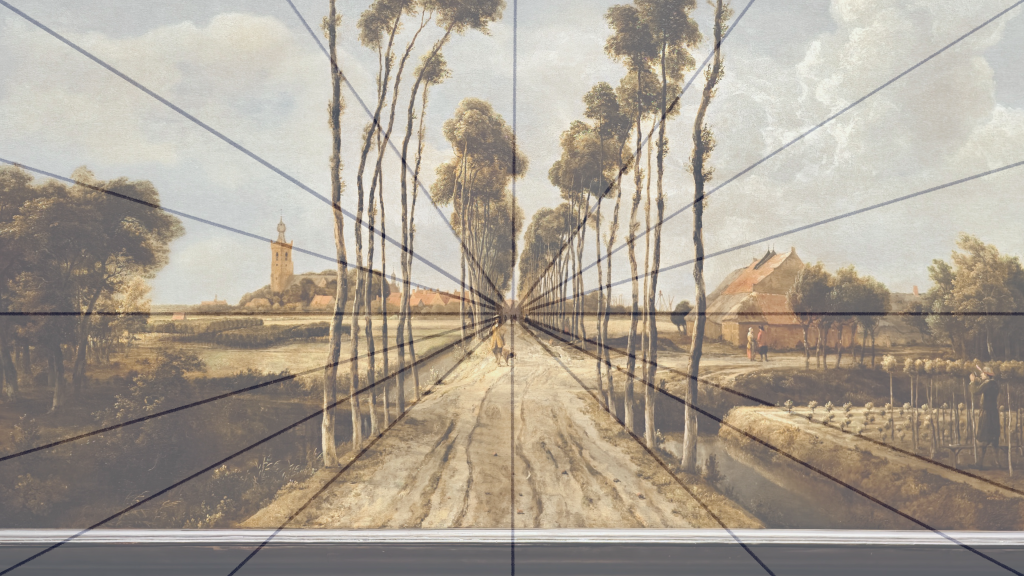
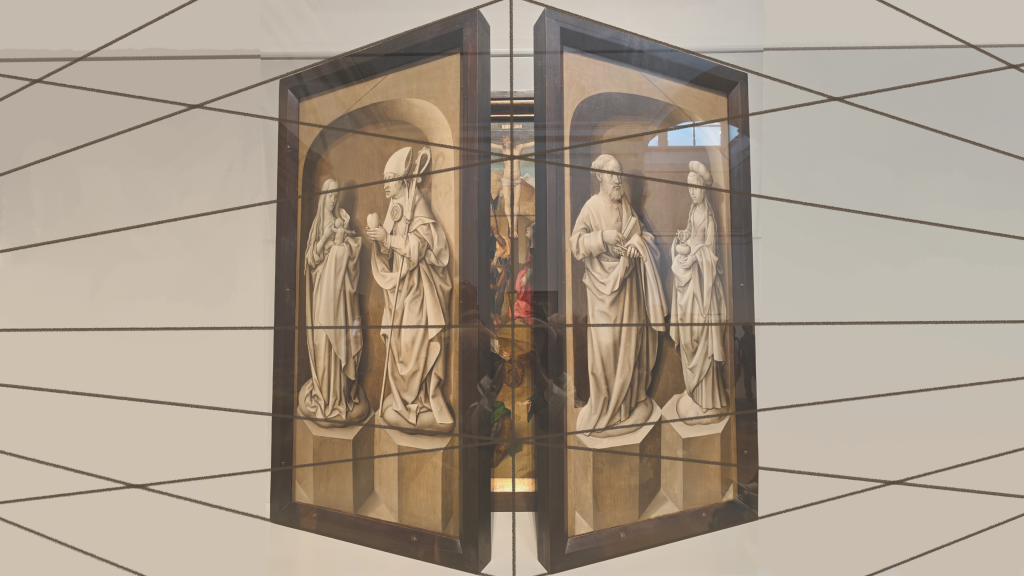
This perspective means that the vanishing point is right in the middle of the frame.
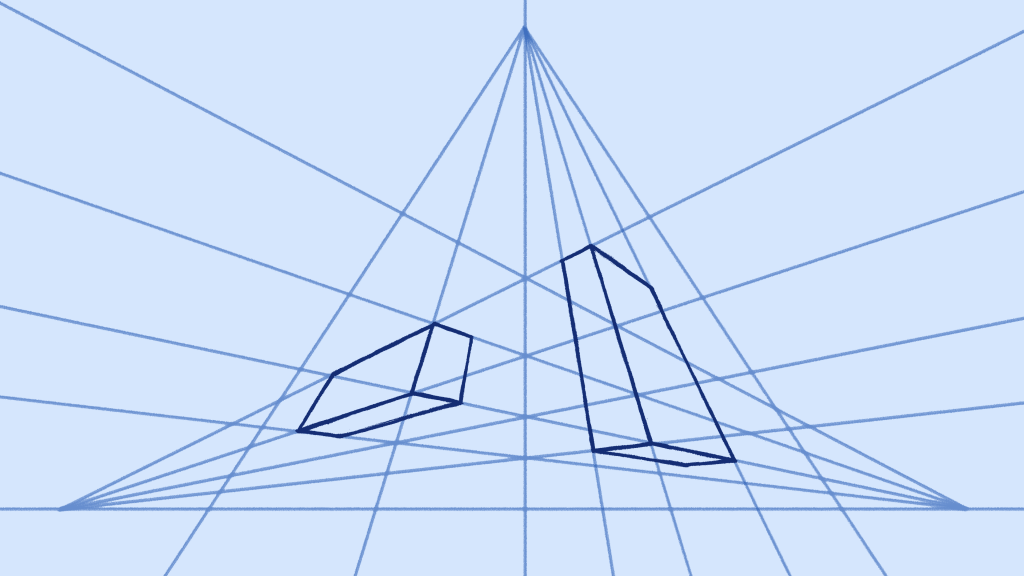
Two point
This perspective means there are two vanishing points at the same height(the horizon line) on the left and right side of the frame.
Three point
This perspective means there are three vanishing points, two at the same height(urually the horizon line) on the left and right side of the frame and one is at the top(looking up, the sky point) or the bottom(looking down, the ground point) of the frame.
Relationship between one-three point perspective
Well the one-point perspective is the special case of two-point perspective, and both of them are the special cases of three point perspective.
Four-point
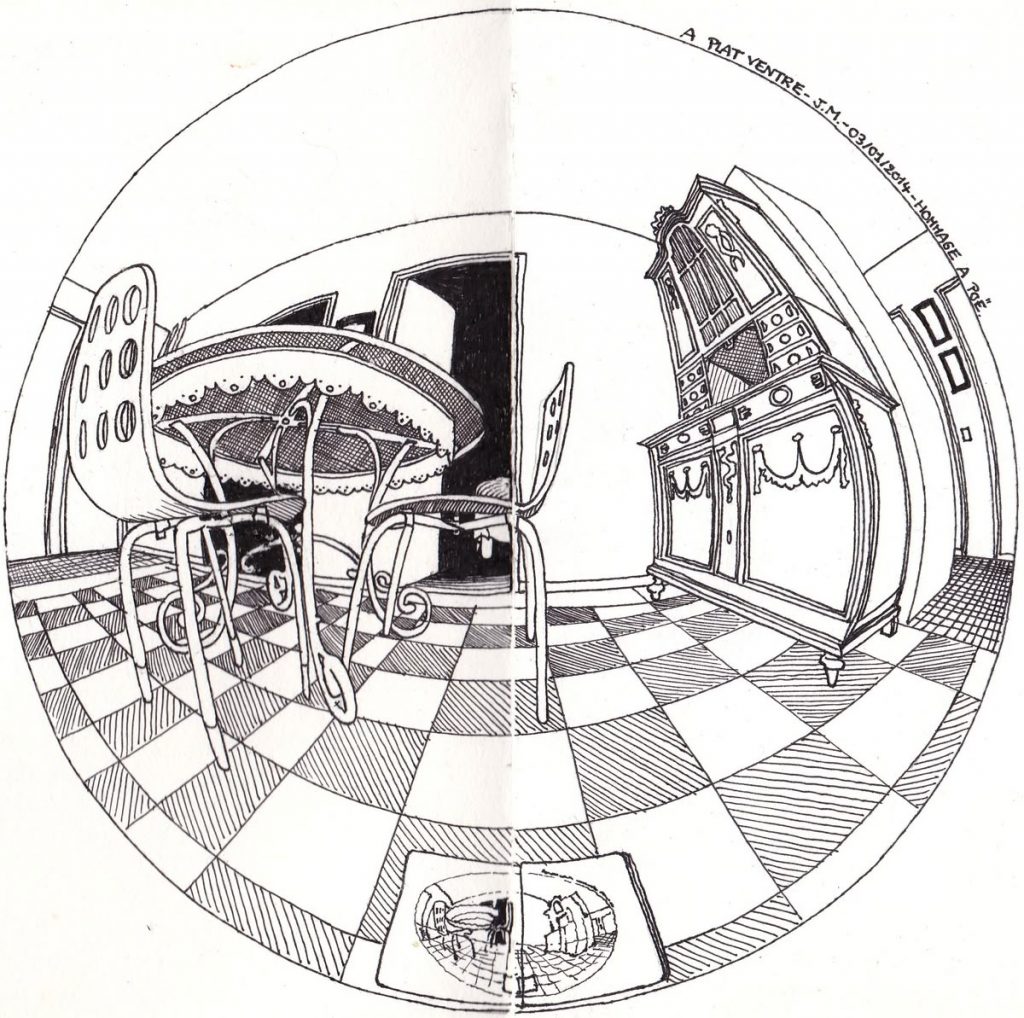
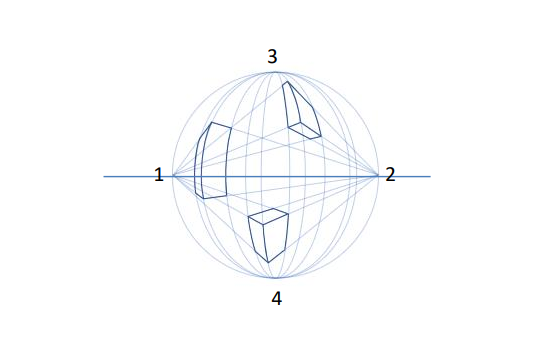
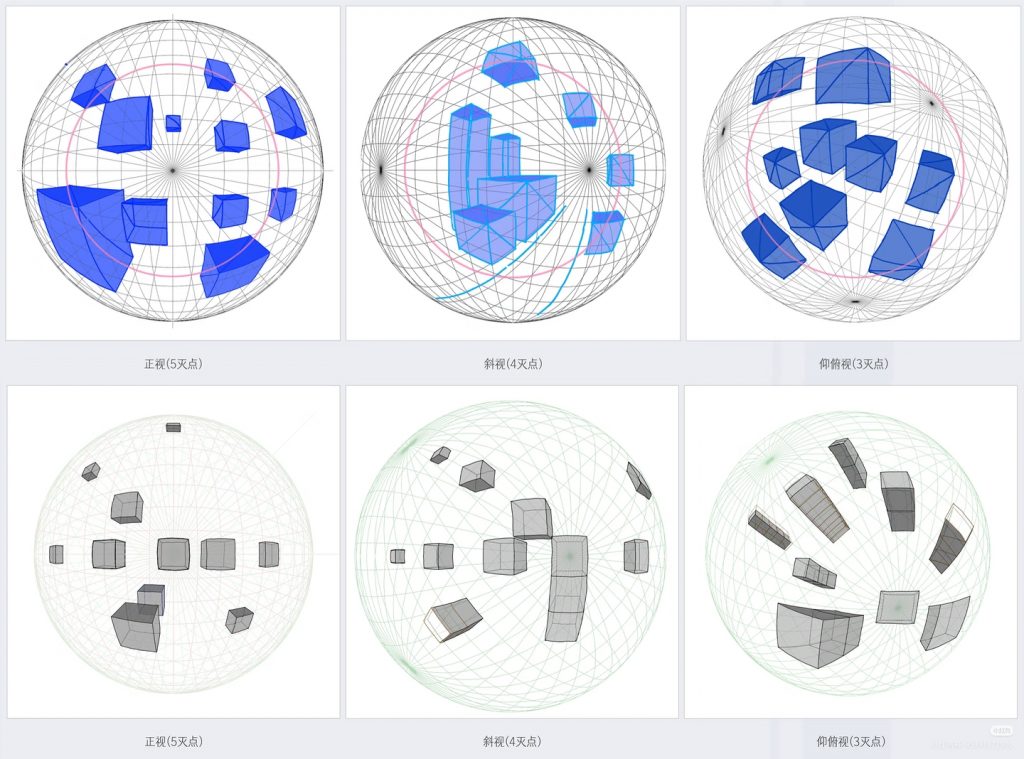
The above perspective is all straight line and you can only see one side on one derection. It’s like if we see xyz coordinate system, we can only see x or -x at one time but can not see both.
This and the below perspectives exist for this purpose. At first let’s just see z-axis and -z-axis at one time and keep the x-axis and y-axis orthogonal. To make this thing come true, we need curve the z-axis lines as follow:
So point 1 is x-axis and point 2 is y-axis, point 3 and 4 make the z-axis.
Five-point
You are not satisfied with stopping here, right? We still have two sides are not able to see! Let’s just move point 2 in the middle to indicate one derection and curve the lines again!
So the horizontal lines represent x-axis, the vertical lines represent z-axis, and the point in the middle means the y-axis perpendicular to the paper.
Six-point
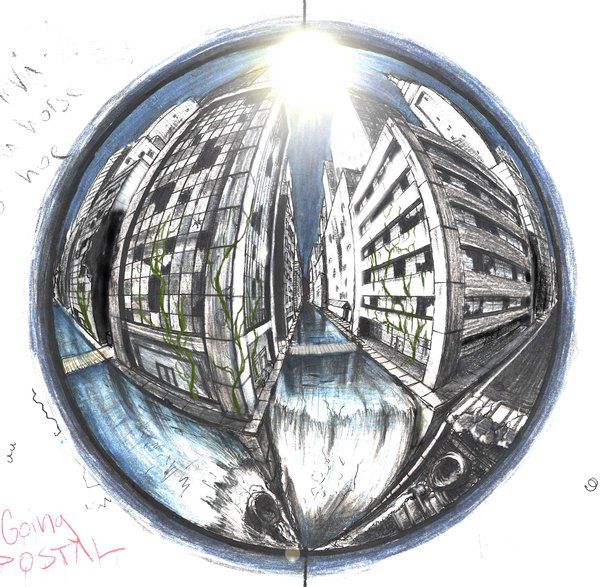
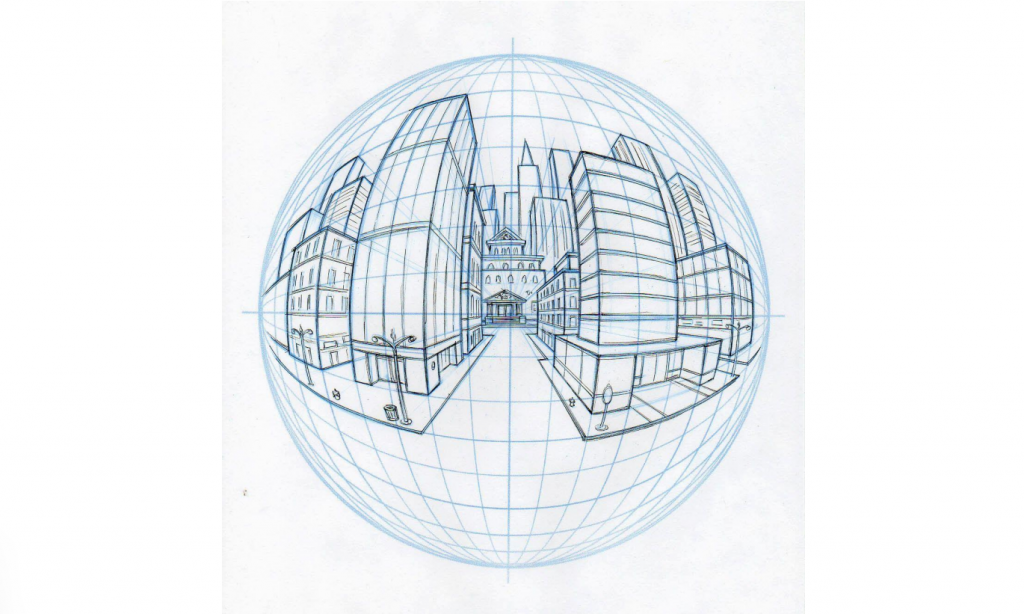
That’s the perspective that confuses me the most. I just can not figure out how to put six points in one circle. But when I see some works in six-point perspective, I find the secret.
The secret is——just draw three points to indicates three direction and move others out of the circle! (Keep the curve lines of course) You can keep two points to indicates one direction by the way, but just only one direction.
As not learn much of how to draw an expression or a head, I try to find a general and easy method to help me determine the location of facial features.